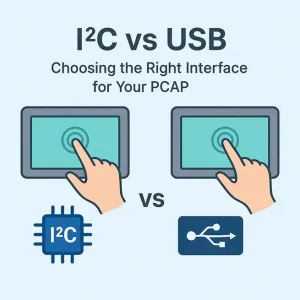
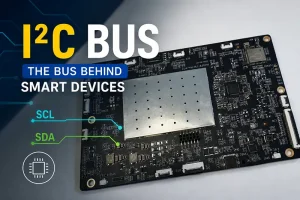
What Is I²C? An In-Depth Look at the Linux I²C Subsystem
Most engineers first meet Linux I2C in a simple way: two wires, one clock, one data line. But once the board is powered on and a device does not respond at 0x68, I2C quickly becomes...
I2C (Inter-Integrated Circuit) is one of the most widely used serial communication interfaces in embedded display and touch systems. Using just two lines — a serial data line (SDA) and a serial clock line (SCL) — I2C lets a host processor talk to multiple peripheral devices over a shared bus, each addressed individually. This simplicity makes it a natural fit for small and mid-size industrial TFT LCD modules, capacitive touch (CTP) controllers, and embedded HMI designs where pin count, board space, and wiring complexity all matter.
At Rocktech, I2C appears across our display and touch product lines, most commonly as the control and reporting channel for projected-capacitive touch panels and for configuration of certain display driver functions. For engineers building compact, reliable products — EV chargers, medical instruments, industrial controllers, smart-home gateways, and kiosks — choosing an I2C-based touch solution keeps the interface footprint minimal while leaving high-bandwidth lanes free for the display signal itself.
Products and features commonly associated with the I2C interface include:
I2C is valued in industrial display design for several practical reasons. First, it is economical on I/O: a single two-wire bus can support many devices, so a touch controller, an EEPROM, and other peripherals can share the same lines without adding connectors or ribbon traces. Second, its addressable, multi-device architecture simplifies system integration — the host reads touch coordinates, gestures, and status from the controller while managing other I2C nodes on the same bus. Third, I2C is well supported across virtually every modern microcontroller, application processor, and Linux/Android-based SBC, including the Rockchip platforms (PX30, RK3566, and others) that power Rocktech's embedded solutions.
For capacitive touch specifically, the I2C controller reports touch events through an interrupt line paired with the bus, allowing the host to poll only when a touch occurs. This reduces processor overhead and power consumption — an important advantage in always-on industrial and IoT devices. Designers should plan for appropriate pull-up resistors on SDA and SCL, confirm the operating bus speed (standard 100 kHz, fast 400 kHz, or faster modes where supported), and verify logic-voltage compatibility (typically 3.3 V) between the host and the display or touch module.
When selecting an I2C touch or display solution, consider the panel size, target bus speed, multi-touch point count, and the host platform's available I2C channels. Rocktech's engineering team can help match the right capacitive touch panel, driver, and optical-bonding option to your interface and mechanical requirements, and provide controller datasheets, register maps, and integration guidance. Browse the products below to find I2C-compatible displays and touch panels.