Embedded SoC (System on Chip)
What Is an Embedded SoC?
An Embedded SoC (System on Chip) is a highly integrated semiconductor solution that combines CPU, GPU, memory controllers, multimedia engines, and peripheral interfaces into a single chip for embedded systems. Unlike traditional PC architectures that rely on multiple discrete components, an embedded SoC consolidates most essential functions into one silicon platform. This integration reduces power consumption, board size, and system complexity while improving reliability.
Embedded SoCs are widely used in industrial control systems, Android/Linux single-board computers (SBCs), smart home panels, medical devices, IoT gateways, and HMI terminals. In these applications, efficiency, long-term stability, and predictable behavior are often more important than peak benchmark performance.
Modern embedded SoCs are typically based on ARM architecture and support operating systems such as Linux, Android, or Buildroot. Their value lies not only in processing capability but also in the ecosystem support, BSP maturity, and long-term supply stability.
Core Components of an Embedded SoC
1. CPU Subsystem
The CPU cores execute the operating system and application software. Most embedded SoCs use ARM Cortex-A series processors for high-level OS environments and may include Cortex-M cores for real-time tasks. Multi-core configurations allow separation of UI, networking, and background processing workloads.
2. GPU and Display Engine
For systems running graphical interfaces, the GPU and display controller are critical. Embedded SoCs support interfaces such as RGB, LVDS, MIPI DSI, HDMI, or eDP. In smart control panels and industrial displays, stable display timing and driver compatibility are essential for long-term operation.
3. Multimedia and Acceleration Blocks
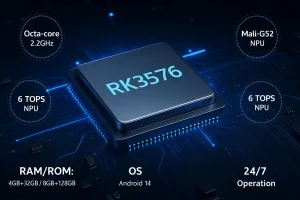
Hardware video encoders and decoders reduce CPU load in applications involving video streaming, surveillance, or multimedia playback. Dedicated acceleration units may support AI inference, image processing, or security functions.
4. Peripheral Interfaces
Embedded SoCs integrate interfaces such as I²C, SPI, UART, USB, Ethernet, PCIe, CAN, and GPIO. The availability and configuration flexibility of these interfaces determine how easily the SoC can connect to sensors, touch panels, cameras, storage, and external modules.
5. Power Management
Integrated power management and clock control allow dynamic frequency scaling and low-power states. For embedded products that run continuously, efficient power design improves thermal stability and overall system lifespan.
Why Embedded SoC Selection Matters
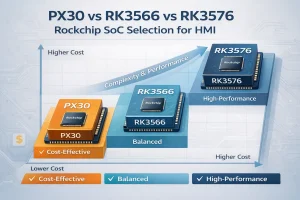
Choosing the right embedded SoC affects not only performance but also development cost and time-to-market. Factors such as BSP quality, kernel support, driver availability, and long-term component supply are often more critical than raw CPU speed.
In industrial and commercial deployments, stability over several years is expected. A well-supported embedded SoC platform allows firmware updates, security maintenance, and hardware revisions without redesigning the entire system architecture.
Ultimately, an embedded SoC serves as the foundation of an intelligent device. When selected and integrated properly, it enables scalable system design, consistent performance, and reliable operation across diverse embedded applications.