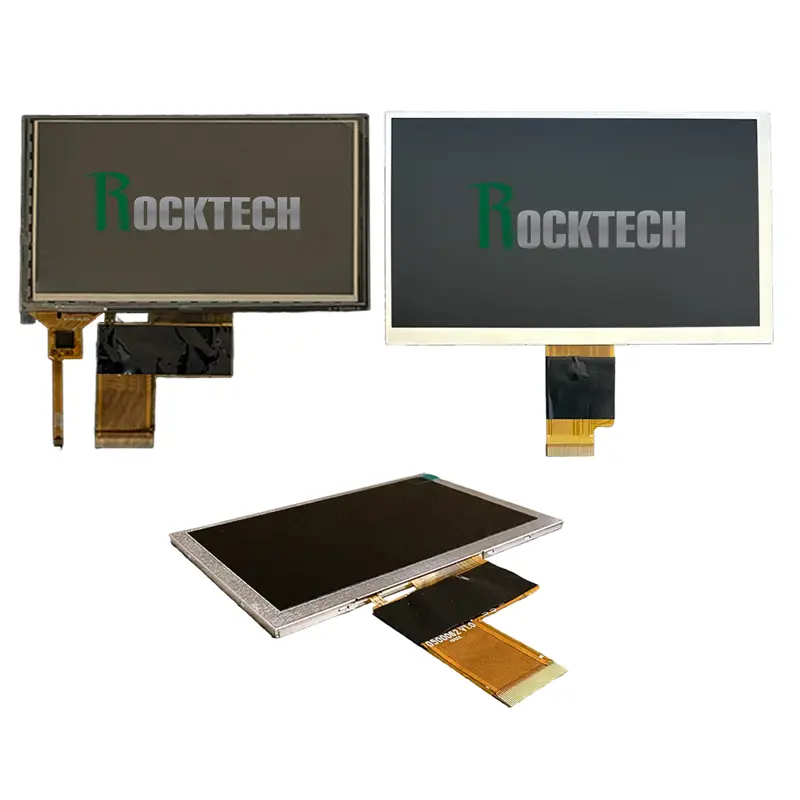
Choosing between the MIPI vs LVDS display interface is one of the first hardware decisions you make when designing an embedded product around a TFT LCD. Both are differential serial interfaces that move pixel data from your SoC to the panel, but they were built for different jobs: MIPI DSI came from the mobile world and favors low power and low pin count over short distances, while LVDS (FPD-Link) is the long-serving workhorse of larger industrial and medical panels. This guide breaks down how each one works, where they win, and how to pick the right interface for your display, cable run, and processor.
MIPI vs LVDS at a glance
The short version: MIPI DSI is the better fit for small-to-medium panels driven directly by a modern SoC over a short flex cable, where power and pin count matter. LVDS is the safer choice for larger panels, longer cable runs, and rugged industrial environments. The rest of this article explains why, so you can defend the decision in a design review.
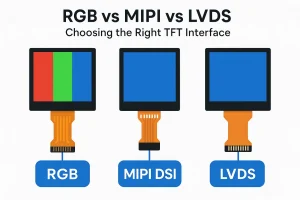
Before the details, it helps to remember a third option you’ll see on smaller modules: parallel RGB. RGB is simple and cheap but uses a wide bus (often 24+ signal lines) and only works over very short distances. MIPI and LVDS both exist largely to solve RGB’s pin-count and reach problems by serializing the data onto a few differential pairs.
What is MIPI DSI?
MIPI DSI (Display Serial Interface) is a standard from the MIPI Alliance, the same group behind the camera interface (CSI) used in nearly every smartphone. It runs over the D-PHY physical layer using differential pairs called lanes.
How MIPI DSI works
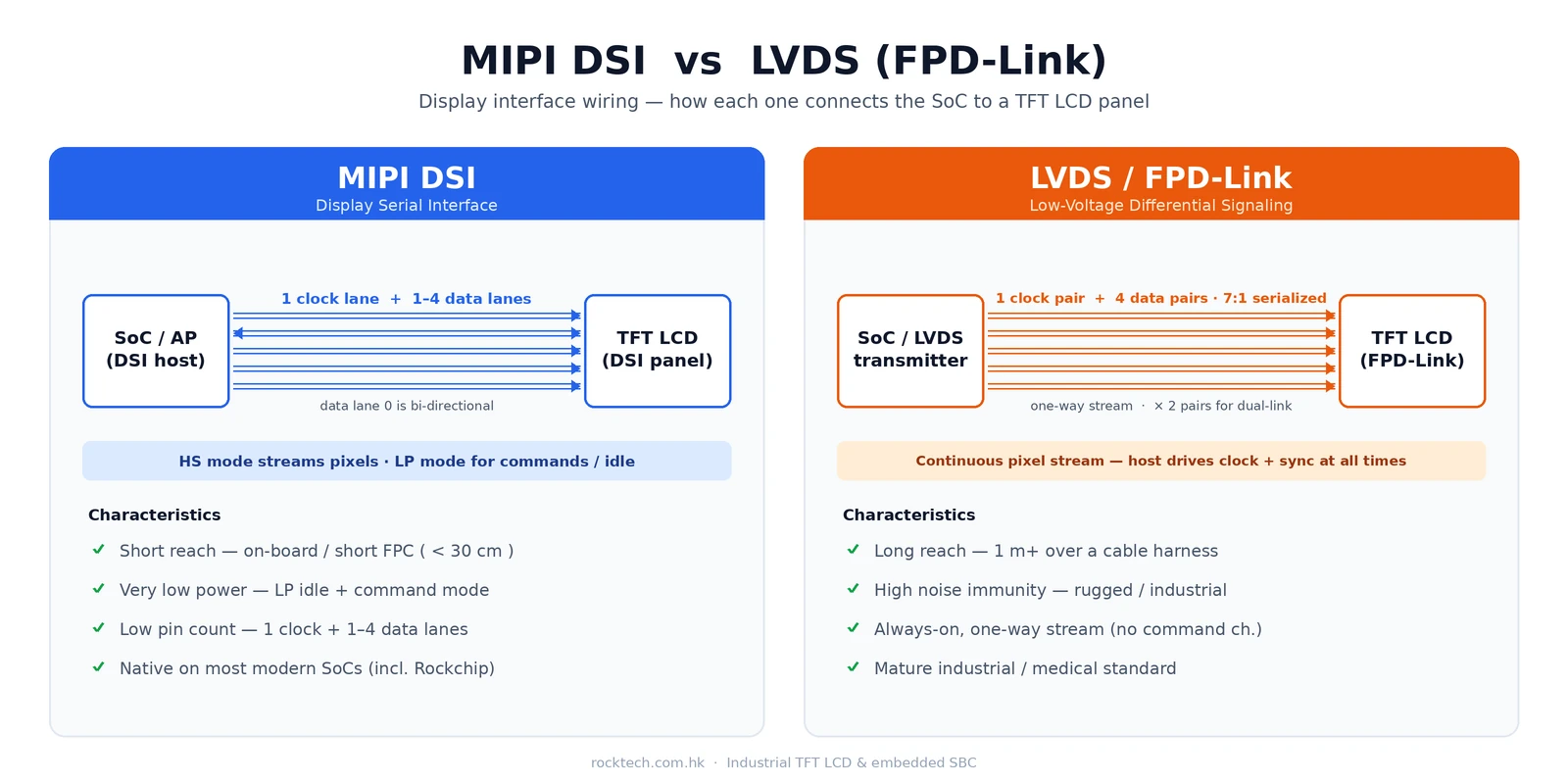
A MIPI DSI link uses one clock lane plus one to four data lanes, each a differential pair. D-PHY has two operating modes:
- High-Speed (HS) mode — differential, low-swing signaling used to stream pixel data. Per-lane rates are commonly around 1–1.5 Gbps, and newer D-PHY versions push higher. Four lanes together comfortably drive Full HD and beyond.
- Low-Power (LP) mode — single-ended, much slower signaling used for commands and for idling between frames. LP mode is a big reason MIPI sips power.
DSI panels also support two operating models. Video mode streams pixels continuously, like a traditional display. Command mode talks to a “smart” panel that has its own frame buffer, so the host only sends updates when the image changes — excellent for battery-powered, mostly-static UIs. Data lane 0 is bidirectional, so the host can also read panel status and ID.
Strengths and limits of MIPI DSI
MIPI’s advantages are low pin count, very low power, low EMI, and native support on virtually every modern application processor. Its main limit is reach: D-PHY is designed for chip-to-chip distances. In practice you keep MIPI on the PCB or on a short flex (FPC), typically well under 30 cm. Stretch it further and signal integrity and EMI become real engineering problems.
What is LVDS?
LVDS (Low-Voltage Differential Signaling) is, strictly speaking, an electrical signaling standard (TIA/EIA-644). When people say a panel “is LVDS,” they almost always mean FPD-Link — the display protocol built on LVDS signaling that has been the default for laptop, monitor, industrial, and medical panels for two decades.
How LVDS works
FPD-Link serializes RGB pixel data, typically at a 7:1 ratio, onto a small set of differential pairs plus a clock pair:
- A single-link 24-bit panel uses 4 data pairs + 1 clock pair.
- A dual-link configuration doubles the data pairs to carry higher resolutions (e.g., Full HD on larger panels).
Throughput scales with the pixel clock: at a single-channel pixel clock of ~85 MHz, each data pair runs at roughly 7 × 85 = ~595 Mbps. Unlike MIPI, LVDS is a “dumb,” one-way streaming interface — there’s no command channel and no frame buffer in the panel, so the host must send a continuous pixel clock plus sync signals at all times.
Strengths and limits of LVDS
LVDS’s headline strength is robustness over distance. Differential signaling gives strong noise immunity, and FPD-Link cleanly drives cable runs of a meter or more — the kind of internal harness you find inside a kiosk, machine, or medical cart. It’s a mature, well-understood, widely second-sourced ecosystem. The trade-offs: it uses more pairs than MIPI for the same data, draws more static power (the links are always on), and lacks any smart/command mode.
MIPI vs LVDS: side-by-side comparison
| Criteria | MIPI DSI | LVDS (FPD-Link) |
|---|---|---|
| Signaling | Differential serial (D-PHY), HS + LP modes | Differential serial (LVDS), continuous |
| Typical pairs | 1 clock + 1–4 data lanes | 1 clock + 3–4 data pairs (×2 for dual-link) |
| Per-lane data rate | ~1–1.5 Gbps (higher with newer D-PHY) | ~pixel clock × 7 (≈595 Mbps at 85 MHz) |
| Practical cable length | Short — on-board / short FPC (typ. <30 cm) | A meter or more over twisted-pair cable |
| Panel size sweet spot | Small to medium (≤ ~10″) | Medium to large (≥ ~10″) |
| Power | Very low (LP mode, idle savings) | Higher (links always on) |
| EMI | Low (low swing + LP idling) | Low vs parallel RGB |
| Smart/command mode | Yes (command + video mode) | No (stream only) |
| SoC support | Native on most modern SoCs (incl. Rockchip) | Common in industrial; often via a bridge |
| Ecosystem | Mobile/embedded, growing fast | Mature industrial/medical standard |
A few of these rows deserve a closer look.
Bandwidth vs pairs. MIPI gets more data through fewer wires because each lane runs much faster. That’s why a 4-lane MIPI link and a single-link LVDS connection use a similar number of pairs, yet MIPI reaches higher resolutions before you need to add hardware.
Cable and environment. This is usually the deciding factor. If the panel sits a few centimeters from the processor on a flex cable, MIPI is ideal. If the display is across the enclosure on a wiring harness — or in an electrically noisy industrial setting — LVDS is the proven answer.
Power. For a handheld or battery device showing a mostly-static screen, MIPI command mode can dramatically cut power. For mains-powered equipment, LVDS’s always-on penalty rarely matters.
Cost and sourcing. Neither interface carries a meaningful licensing cost, so the price difference shows up in the surrounding hardware. MIPI’s lower pin count can mean a simpler, cheaper connector and flex, but tight impedance control and short routing raise PCB-layout effort. LVDS connectors and cable assemblies are inexpensive, second-sourced, and forgiving to route, which is part of why the industrial supply chain still leans on them. If you add a bridge IC to cross between the two, factor in its part cost, board area, and an extra component to qualify.
Refresh and resolution headroom. Think about where the product is going, not just where it starts. If a future revision bumps resolution or refresh rate, MIPI lets you add lanes and LVDS lets you move to dual-link — but both have a ceiling. Sizing the interface with headroom now is cheaper than respinning the board later.
How to choose: MIPI or LVDS for your project
Choose MIPI DSI if:
- Your panel is small to medium (roughly 10″ and under) and sits close to the SoC.
- You’re power- or battery-constrained, or your UI is mostly static (command mode wins here).
- You want the lowest pin count and your processor already exposes MIPI DSI — which most modern SoCs, including Rockchip parts, do.
- The display connects via a short FPC, not a long cable.
Choose LVDS if:
- Your panel is medium to large (10″ and up) or higher-resolution.
- The display is physically distant from the board or runs through a cable harness.
- You’re building for a rugged, EMI-heavy industrial environment where robustness beats power savings.
- Your supply chain or platform is already standardized on LVDS panels.
What about interface bridges?
You’re not locked in by your SoC. Bridge ICs convert between interfaces in both directions — MIPI-to-LVDS bridges let a MIPI-only processor drive a large LVDS panel, and LVDS-to-MIPI bridges do the reverse. Bridges add cost, board area, and a small amount of latency, but they’re a clean way to reuse a panel you like with the processor you’ve chosen. On Rockchip platforms, MIPI DSI is exposed natively, and LVDS panels are driven either through the SoC or a bridge — a mapping decision best made early, alongside connector and cable selection.
How Rocktech Can Help
Rocktech has spent 15+ years building industrial TFT LCDs and 10+ years on embedded boards, so interface selection is something we do on nearly every project. If MIPI is the right call, our MIPI TFT display range covers the small-to-medium sizes where DSI shines; if your design needs reach and ruggedness, our LVDS TFT displays are built for it. Both lines sit under our broader industrial TFT display portfolio, where we can match panel, touch, and cover lens to your environment.
Because we’re an official Rockchip board-design partner, we can also pair the panel with an Android or Linux SBC and handle the MIPI/LVDS mapping — including any bridge — as part of one integrated module. For more on going from a bare display to a full platform, see our embedded platform guide.
Frequently Asked Questions
Is MIPI faster than LVDS?
Per lane, yes — MIPI D-PHY runs around 1–1.5 Gbps per lane (higher with newer versions), while a single LVDS data pair is closer to ~595 Mbps at an 85 MHz pixel clock. But LVDS scales with dual-link configurations, and for most panels both interfaces have enough bandwidth; cable length and power usually decide the choice, not raw speed.
Can I run MIPI over a long cable?
Not reliably. MIPI DSI is designed for short, on-board or short-FPC distances (typically under 30 cm). For longer runs, use LVDS or add a MIPI-to-LVDS bridge near the panel.
Does my processor support MIPI or LVDS?
Most modern application processors — including Rockchip SoCs such as the RK3566 and PX30 — expose MIPI DSI natively. LVDS is often provided through the SoC or a bridge IC. Check your specific processor’s datasheet, or ask us and we’ll confirm against your platform.
What’s the difference between LVDS and FPD-Link?
LVDS is the underlying electrical signaling standard; FPD-Link is the display protocol built on top of it. In everyday usage, ‘an LVDS panel’ means an FPD-Link panel.
Can I convert between MIPI and LVDS?
Yes. Bridge ICs convert in both directions, letting you mix a preferred panel with a preferred processor at the cost of a little board space and BOM.
Conclusion / Next Steps
There’s no universally “better” interface — there’s the one that fits your panel size, cable run, power budget, and processor. As a rule of thumb: reach for MIPI DSI on compact, power-sensitive, SoC-adjacent displays, and LVDS on larger panels, longer harnesses, and rugged industrial builds. If you’d like a second opinion on a specific design, send us your resolution, size, and cable length, and we’ll recommend an interface — and a panel to match.