Industrial LCD Panel vs Consumer Display: Key Differences
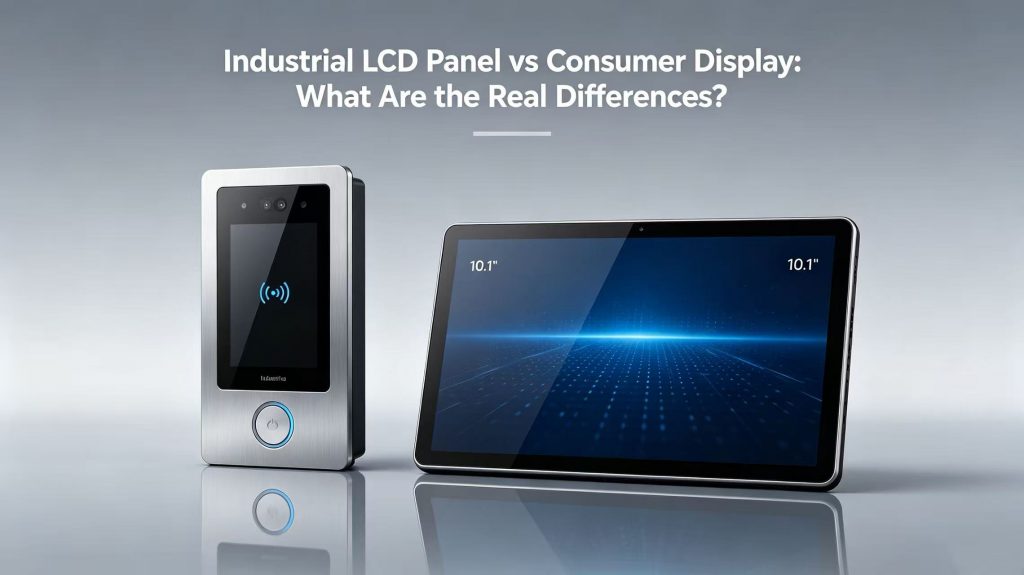
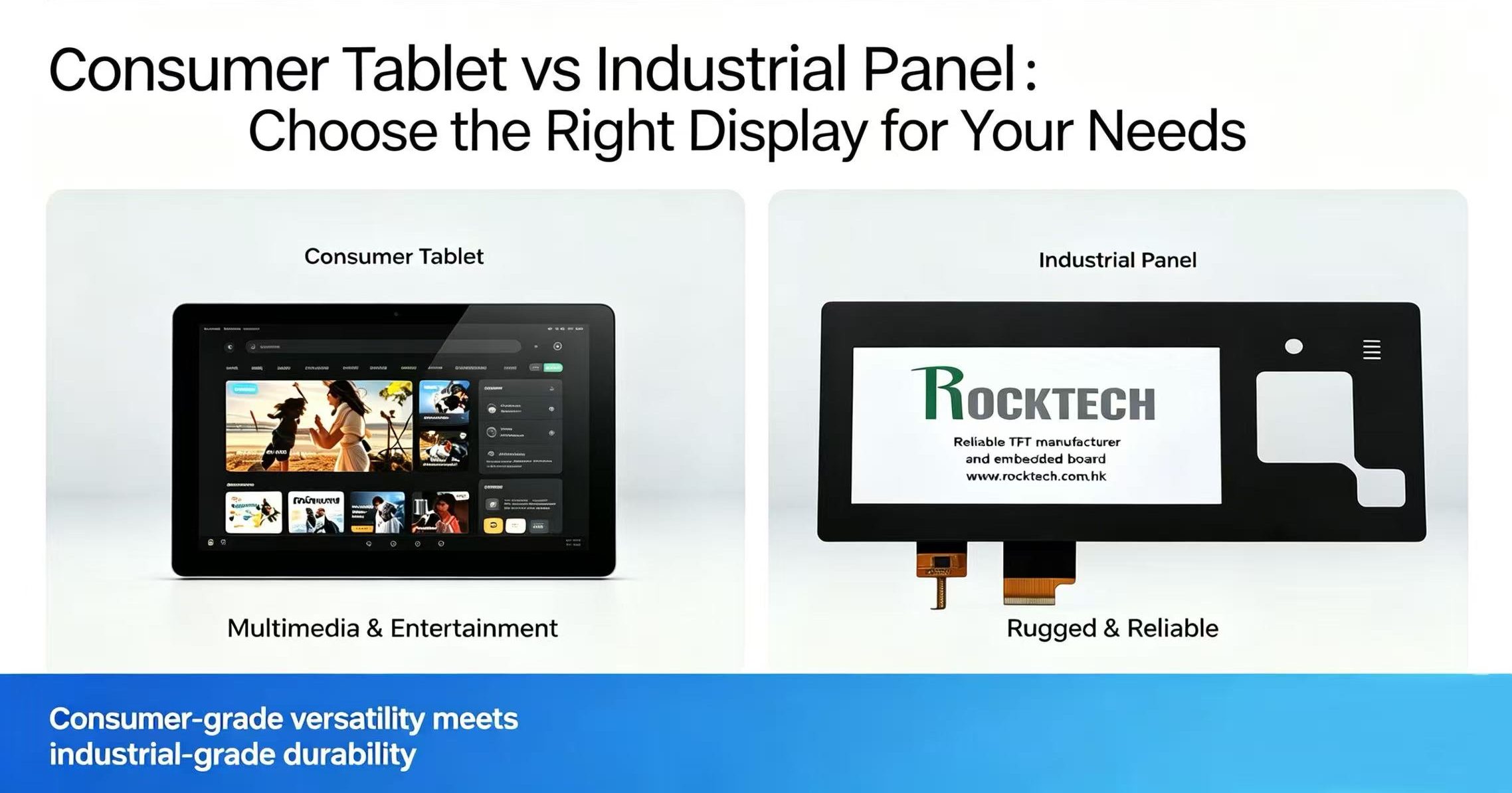
Although industrial and consumer displays may look similar on the surface, they are actually designed for very different purposes. In many projects, the biggest misunderstanding comes from assuming that a consumer screen can directly replace an industrial LCD panel without affecting system stability, product lifecycle, or integration difficulty.
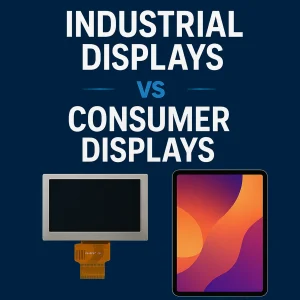
The table below summarizes some of the most important differences between an industrial display solution and a typical consumer display product.
| Factor | Industrial LCD Panel | Consumer Display |
|---|---|---|
| Supply Cycle | Usually available for 5–10 years or longer | Models may be discontinued very quickly |
| Customization | High flexibility for touch, brightness, cover glass, cables, and housing | Very limited customization options |
| Operating Temperature | Designed for wider temperature environments | Mostly designed for normal indoor use |
| Brightness | High brightness and sunlight readable options available | Standard brightness only |
| Touch Design | Can support glove touch, wet touch, waterproof designs | Mainly optimized for finger touch |
| Interface | LVDS, MIPI, RGB, eDP, HDMI and other embedded interfaces | Mostly closed internal ecosystem |
| Integration | Easier integration with embedded display board and industrial systems | Integration can be difficult |
| MOQ | Small batch and niche projects are possible | Usually optimized for large consumer volumes |
| Cost Structure | Engineering and reliability focused | Mass production and low-cost focused |
One thing worth mentioning is that industrial products are not necessarily “better” in every situation. Consumer displays are actually very cost efficient because they are manufactured in extremely large quantities. This is one of the reasons why tablets and commercial monitors can sometimes look cheaper compared to an industrial display solution.
However, industrial LCD panels are usually developed with completely different priorities. In many industrial or embedded projects, customers care more about stable supply, long-term maintenance, hardware compatibility, and customization capability than simply achieving the lowest initial hardware cost.
This is also why many companies eventually move from consumer devices to a custom LCD display or industrial touch screen display after facing issues such as discontinued products, unstable supply chains, or integration limitations in real applications.
Why Industrial LCD Panels Usually Cost More
One of the most common questions customers ask is why an industrial LCD panel often costs much more than a consumer tablet or a commercial display with a similar screen size. In reality, the LCD glass itself is usually not the main reason. The cost difference comes from the overall product strategy, engineering effort, and long-term requirements behind industrial applications.
Consumer electronics are built on massive production volumes. A popular tablet model can easily ship millions of units, which spreads the cost of components like display, processor, memory, and mechanical parts across a huge quantity. Industrial products, on the other hand, are usually produced in much smaller batches, sometimes only a few hundred or a few thousand units per year.
Key Cost Drivers in Industrial LCD Panel Projects
| Cost Factor | What It Means in Real Projects |
|---|---|
| Low production volume | Higher unit cost due to limited scale |
| Long lifecycle requirement | Extra planning to keep supply stable for years |
| Customization | Non-standard design for touch, brightness, structure |
| Embedded integration | Matching with different embedded display board platforms |
| Reliability testing | Extra validation for harsh environments |
Q&A Style Breakdown
Q: Why does low volume affect price so much?
A: Because industrial LCD panels are not mass-produced like consumer tablets. If only 500–2000 units are needed per year, the supplier cannot spread tooling, engineering, and logistics costs across a large base. So the unit price naturally becomes higher.
Q: Isn’t the display itself the same glass as consumer products?
Sometimes existing tooling can even be reused, making customization much more affordable than customers initially expect.
Q: What is “hidden cost” in industrial display projects?
A: It is usually not obvious at the beginning. Things like embedded display board compatibility, long-term supply planning, and reliability testing (temperature, vibration, EMC) all add engineering time and validation cycles. These are not visible in the BOM, but they are essential.
Why This Matters in Real Projects
If you look at it from a system point of view, the cost of an industrial LCD panel is not just “a screen price”. It is more like paying for:
- Stability over 5–10 years
- Integration with embedded systems
- Custom design for real environments
- Reduced risk of redesign later
This is why industrial display solution providers usually focus less on “unit price comparison”, and more on whether the display can actually survive the full product lifecycle.
When Does a Custom LCD Display Make More Sense?
A custom LCD display is not always necessary for every project, but in many real-world applications, it actually becomes the more practical and long-term stable choice. The key point is not only about performance, but about how well the display can fit into the overall system design, supply chain plan, and product lifecycle.
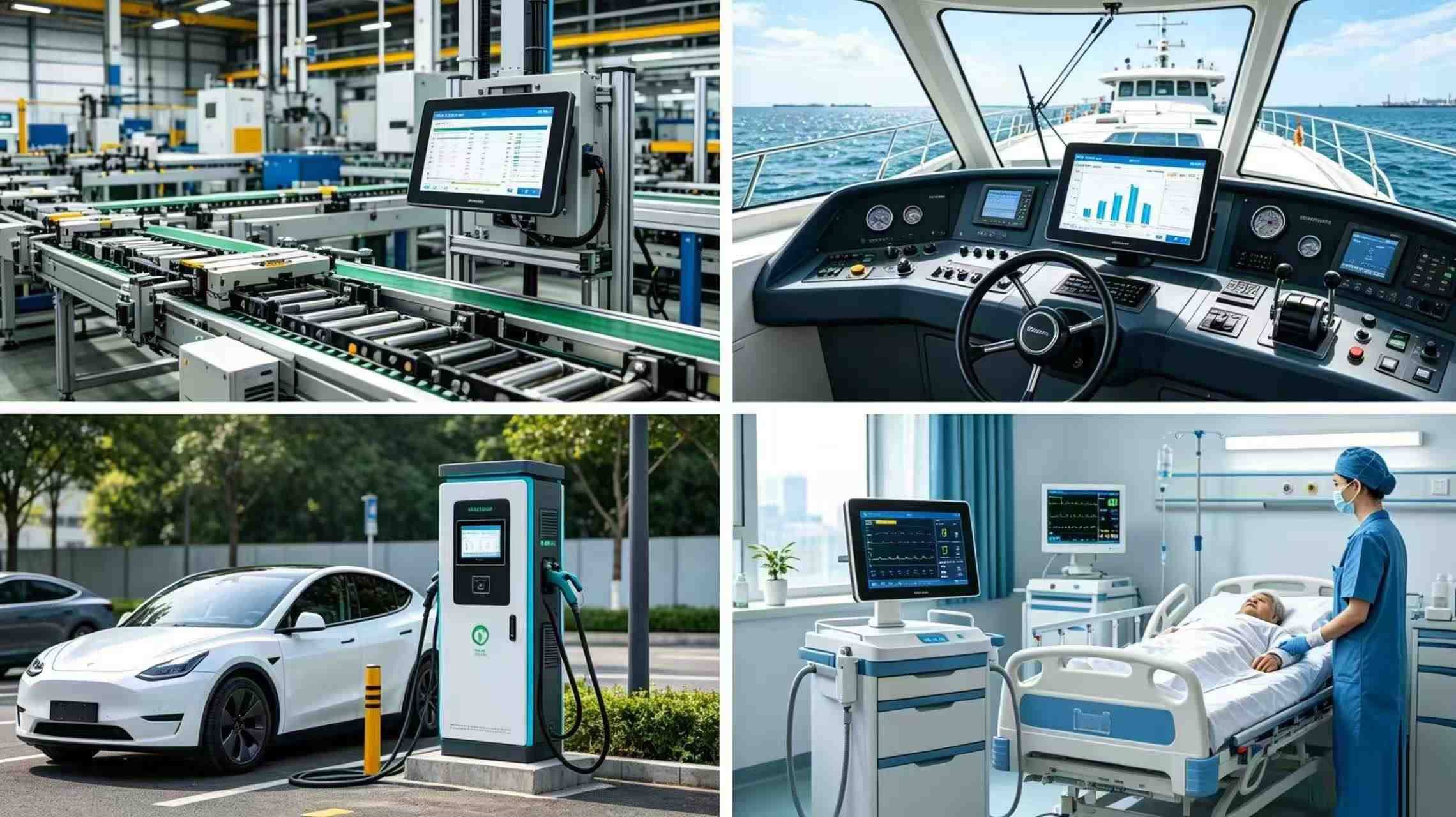
Typically, industries that benefit the most from a custom LCD display are those where devices are used in professional, semi-industrial, or mission-critical environments. For example, in medical equipment, display stability and long-term availability are extremely important because the device may need to stay in service for many years without major hardware changes. In industrial automation, displays are often integrated into control systems where interface consistency and reliability matter more than cosmetic design.
Other common applications include fitness equipment, smart agriculture systems, marine electronics, EV charging stations, smart home control panels, and handheld industrial terminals. In all of these cases, the display is not just a visual component, but part of a larger embedded system that needs to work reliably in different environments.
What these markets have in common is that they are often niche applications. The annual volume may not be extremely high compared to consumer electronics, but the requirements are usually much more specific. Customers in these fields often need stable supply over multiple years, flexible interface options, mechanical compatibility with their housing design, and long-term technical support from the supplier.
This is exactly where an industrial display solution or an embedded display board approach becomes more valuable. Instead of forcing a standard consumer product into a specialized application, a custom LCD display allows the system to be designed around the actual use case, which can significantly reduce integration risk and long-term maintenance issues.
The Advantage of Working With an Industrial Display Solution Provider
In many niche or specialized industries, the real challenge is not just selecting a display, but finding a solution that actually fits into the whole system. Standard consumer products are often designed for mass markets, so they don’t always match the requirements of embedded systems, industrial environments, or long-life-cycle equipment. This is where working with an industrial display solution provider becomes more meaningful.
Instead of trying to force a standard product into a specific application, a professional supplier can help bridge the gap between display technology and real project needs. For example, a proper industrial display solution provider can help customers shorten development cycles by offering pre-validated platforms and reference designs. It also helps reduce integration risks, especially when dealing with different embedded display boards, interfaces, or processor platforms.
In many cases, customization is not just an option but a necessity. This includes adjusting touch performance, supporting different interfaces, or modifying mechanical structures to fit the final housing design. At the same time, ensuring long-term supply consistency is another key point, especially for projects that are expected to run for several years without redesign.
Another important aspect is cost optimization. Instead of simply choosing the cheapest components, a good solution provider usually helps balance performance, reliability, and application requirements, so the final design makes more sense from a system level, not just a single component level.
How to Choose Between an Industrial LCD Panel and a Consumer Display
Choosing between an industrial LCD panel and a consumer display is not always straightforward, and in many early-stage discussions, customers tend to focus mainly on price. However, the right choice usually depends more on the application requirements than on the initial cost alone.
If the main priority of the project is low upfront cost and fast consumer-level deployment, then a consumer display might be enough. It works well for short lifecycle products, simple indoor applications, or devices that do not require long-term hardware stability or deep system integration.
However, if the project requires higher reliability, stronger system integration, longer product lifecycle, customization options, or operation in industrial environments, then an industrial LCD panel is usually the more suitable choice. In these cases, the display is not just a standalone component, but part of a complete industrial display solution that needs to work consistently with the embedded system over time.
In real applications, the decision is often not about which one is “better,” but which one matches the actual use case. Once the requirements become clearer, the right direction usually becomes much easier to define.