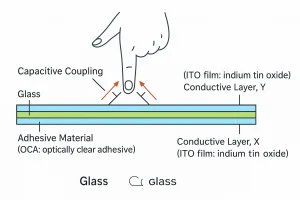
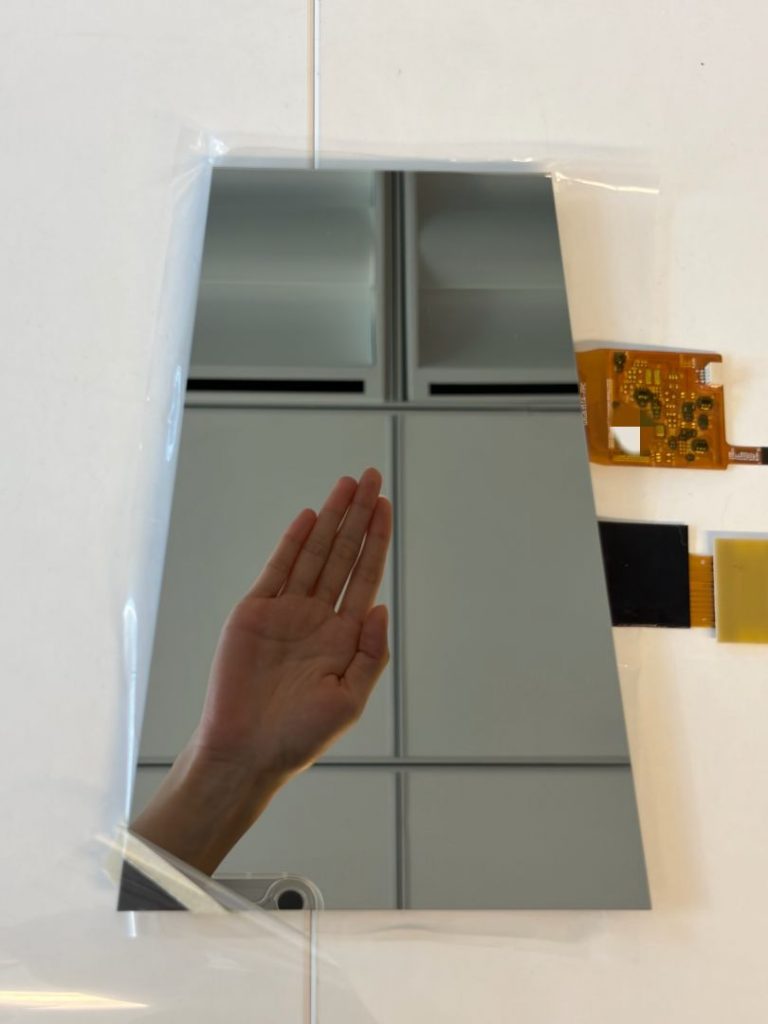
Demand for Mirror Touch Screen solutions has grown steadily in recent years, particularly in smart home devices, healthcare equipment, and premium appliances.
At the beginning of many projects, the focus is usually on appearance. Companies want a display that stays hidden behind a mirror surface and blends naturally into the product design. Once development moves into prototype testing, priorities often change. Brightness, touch response, thermal management, and long-term reliability quickly become part of the discussion.
That’s where mirror display projects tend to get more complex.
Compared with standard TFT LCD products, mirror displays require a careful balance between usability and visual design. The display must remain readable, while the mirror effect still needs to feel natural in everyday use.
Today, mirror TFT LCD technology is commonly used in:
- Smart bathroom mirrors
- Beauty and makeup devices
- Fitness mirrors
- Smart appliances
- Healthcare terminals
- Industrial hidden-display systems
For many OEM manufacturers, mirror displays provide a practical way to modernize product design without completely changing the system architecture.
What Is a Mirror Touch Screen?
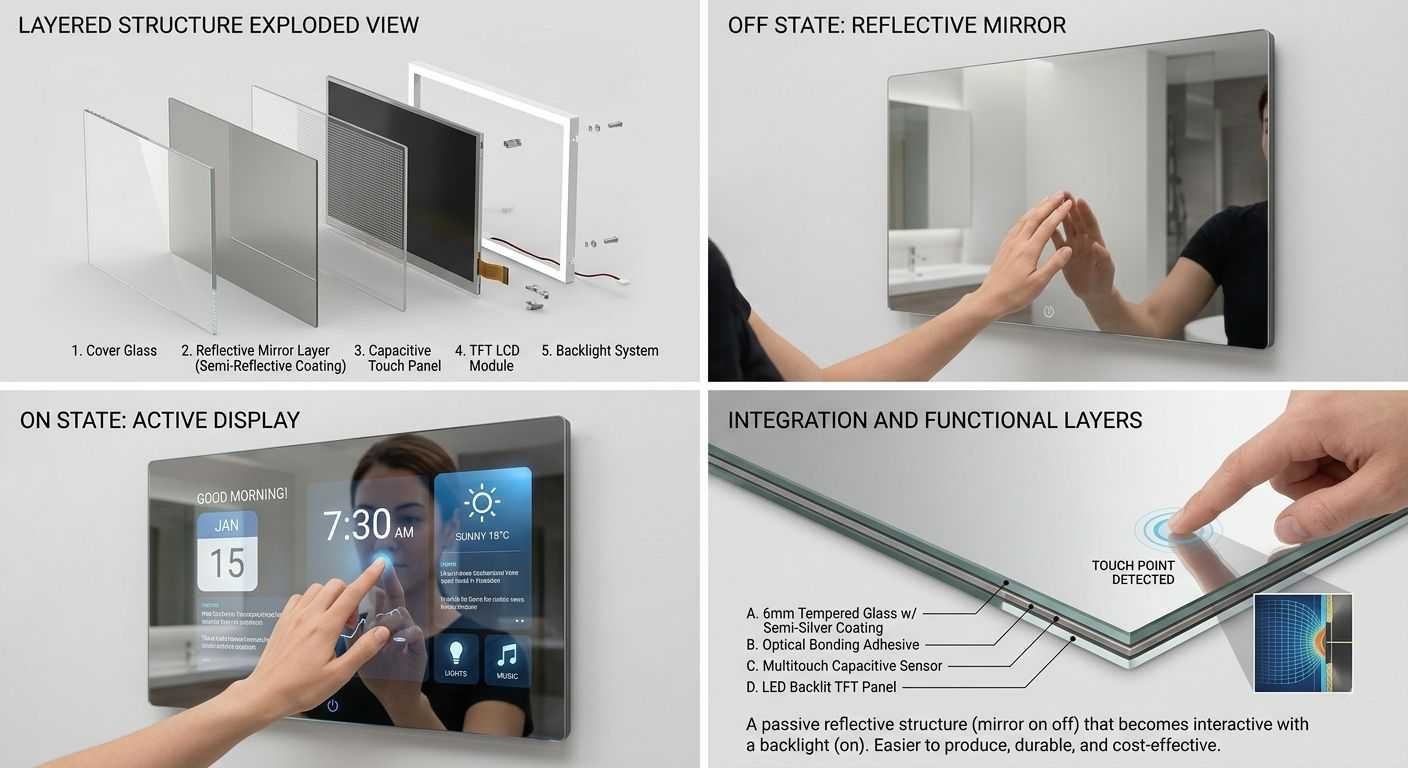
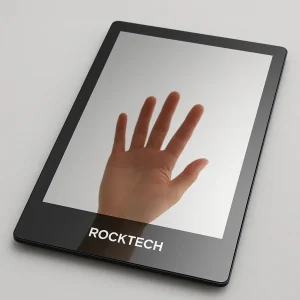
A Mirror Touch Screen is a TFT LCD display installed behind a semi-reflective mirror surface.
A typical structure includes:
- Cover glass
- Reflective mirror layer
- Capacitive touch panel
- TFT LCD module
- Backlight system
When the display is off, the surface functions like a standard mirror. Once the backlight turns on, interface content becomes visible through the reflective layer.
Most smart mirror products use passive reflective structures instead of active smart glass technologies. The reason is straightforward. Passive systems are easier to manufacture, more stable over long-term use, and generally more cost-effective for commercial applications.
Why Passive Mirror Displays Are More Common
Some companies initially consider active smart glass because the technology appears more advanced on paper.
In actual product development, passive reflective mirror displays remain the more common choice.
The advantages are practical:
- Lower system complexity
- Better long-term stability
- Easier optical tuning
- More mature supply chain
- Lower overall cost
For most consumer and industrial products, those factors matter more than electrically switchable glass.
Why More OEM Projects Are Using Mirror TFT LCD Displays
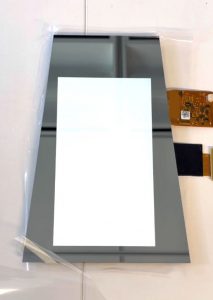
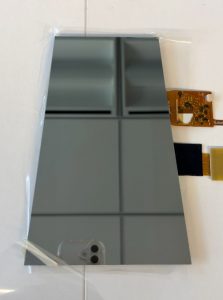
A growing number of brands want displays to feel less visible when they are not in use. This trend is especially noticeable in smart home products.
Instead of exposing a traditional screen on the product surface, manufacturers now prefer hidden-display designs with cleaner visual integration. A mirror interface helps the product blend more naturally into modern interiors.
Hidden Displays Create Cleaner Product Designs
When the system powers off, the display nearly disappears into the mirror surface.
This hidden-display approach is now common in:
- Smart bathroom mirrors
- Smart fitness equipment
- Luxury appliances
- Elevator control panels
- High-end coffee machines
For premium devices, appearance is often just as important as functionality.
Touch Interaction Still Requires Careful Tuning
From the outside, a mirror surface may look simple. In development, touch performance still requires careful adjustment.
Depending on the application, customers may require:
- Waterproof touch
- Wet-hand operation
- Multi-touch gestures
- Glove support
Bathroom and healthcare projects are usually more demanding in this area.
Android and SBC Solution Integration Is Increasing
Android-based systems and embedded SBC solution platforms are becoming more common in mirror display projects.
Many systems now integrate:
- Wi-Fi connectivity
- Voice assistants
- Smart home control
- Camera modules
- AI functions
As a result, interface compatibility has become more important than before.
Brightness Is Usually the Main Challenge
In most mirror display projects, brightness becomes the biggest issue during testing.
At first, many customers focus heavily on achieving a strong mirror effect. Once the prototype powers on, they often realize the display underneath looks darker than expected.
That’s normal.
The Mirror Layer Reduces Light Transmission
A mirror display reflects ambient light while still allowing the TFT LCD image to pass through the reflective layer.
The trade-off is unavoidable:
- Stronger mirror effect = lower display visibility
- Higher transparency = weaker mirror appearance
The right balance depends on the application.
For example:
- Smart bathroom mirrors usually prioritize mirror appearance
- Retail displays typically prioritize readability and brightness
High Brightness TFT LCD Panels Are Commonly Used
To offset brightness loss, many projects use high brightness TFT LCD modules.
Typical brightness levels include:
- 800 nits
- 1000 nits
- 1500 nits
Larger displays and brighter environments often require higher brightness.
Some projects begin with standard consumer panels to reduce cost. After testing, many customers move to higher brightness solutions because readability becomes an issue.
Optical Bonding Improves Visual Performance
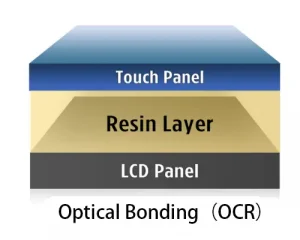
Optical bonding has become increasingly common in mirror display systems.
Without bonding, internal reflections can become noticeable under strong lighting conditions.
Proper optical bonding helps improve:
- Contrast
- Viewing experience
- Sunlight readability
- Overall visual quality
The difference is often obvious on larger mirror TFT LCD displays.
Common Applications for Mirror Touch Screen Technology
Mirror displays are no longer limited to concept products or luxury installations.
They are now widely used across commercial and industrial markets.
Smart Bathroom Mirror Displays
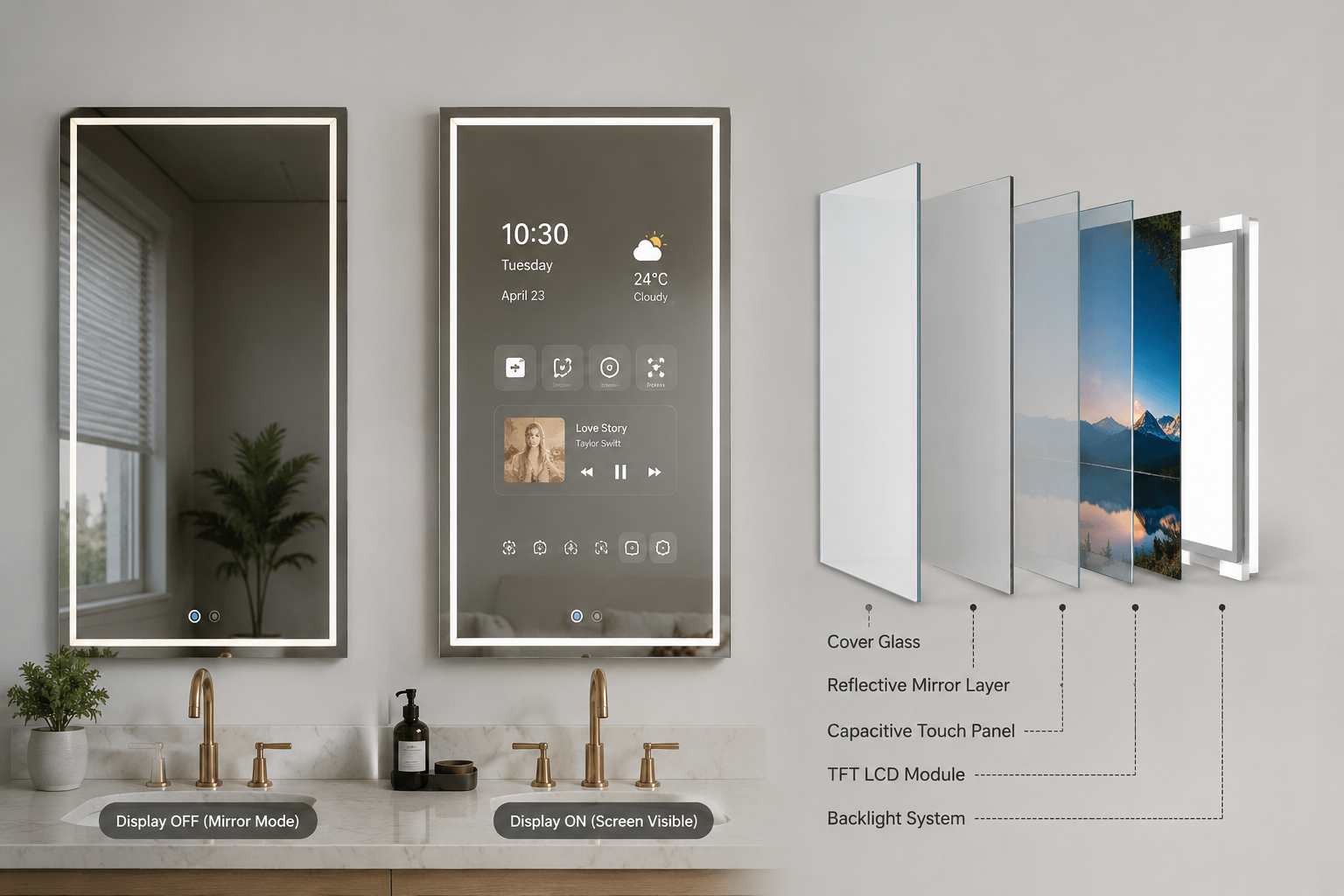
This remains one of the largest application areas.
Modern systems may include:
- Time and weather
- Lighting control
- Voice assistants
- Smart home interfaces
- Health monitoring features
At the same time, users still expect the mirror to function naturally for everyday use.
Beauty and Makeup Devices
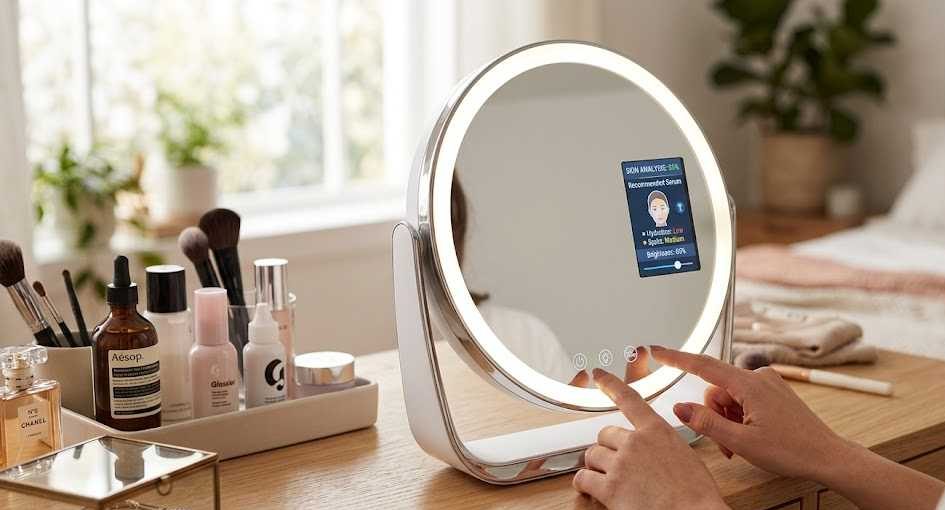
Beauty mirrors have become more interactive in recent years.
Some systems now integrate:
- Skin analysis
- Adjustable lighting
- Touch controls
- Personalized recommendations
Compact small size TFT display modules are often used to keep the product slim and visually clean.
Interactive Retail Displays

Retail environments are also adopting mirror displays more frequently.
Compared with traditional signage, interactive mirrors tend to attract more attention because users naturally approach the mirror surface.
Typical applications include:
- Virtual fitting systems
- Smart advertising
- Product recommendation displays
Healthcare and Medical Equipment
Healthcare applications continue to grow steadily.
Mirror displays are now used in:
- Rehabilitation guidance systems
- Smart medical terminals
- Remote consultation equipment
- Healthcare monitoring systems
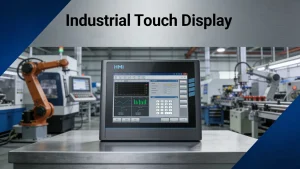
In medical and industrial environments, many manufacturers prefer using an industrial LCD panel because lifecycle stability is often more important than initial cost.
Choosing the Right Mirror Touch Screen Solution
Selecting a mirror display is not only about appearance.
Several technical factors directly affect the final user experience.
Display Size Should Match the Application
Popular mirror TFT LCD sizes include:
For compact products, small size TFT display modules remain the most common option.
Reliability Matters in Long-Term Projects
Consumer-grade displays may perform well during early evaluation.
For mass production projects, long-term supply stability becomes more important. That is one reason many manufacturers move toward industrial LCD panel solutions.
Industrial-grade displays generally provide:
- Longer product lifecycle
- Better temperature performance
- Improved reliability
- More stable supply
Thermal Design Should Not Be Overlooked
Higher brightness panels generate more heat.
In mirror display systems, airflow is often limited because the display sits behind multiple glass layers.
During development, thermal management is something many teams underestimate early in the project.
Future Trends in Mirror Touch Screen Technology
The smart mirror market continues to expand, supported by increasing adoption in smart home, retail, fitness, and healthcare applications.Smart Mirror Market Report – Fortune Business Insights
Several industry trends are becoming more visible across both consumer and industrial applications.
AI Features Are Expanding
More manufacturers are exploring:
- Facial recognition
- Gesture control
- Health analysis
- Personalized interfaces
These features are becoming increasingly common in smart mirror products.
Hidden Displays Are Becoming More Mainstream
A few years ago, hidden displays were mostly limited to premium devices.
Today, they are appearing in a much wider range of products, including:
- Home appliances
- Smart furniture
- Commercial equipment
- Industrial systems
As TFT LCD technology continues to improve, mirror displays are becoming easier to integrate into mainstream products.
Conclusion
Mirror Touch Screen technology has moved well beyond niche applications.
For many OEM projects, mirror TFT LCD solutions provide a practical balance between modern product design, touch interaction, and system integration.
There are still technical challenges, especially in brightness tuning and optical performance. Even so, improvements in high brightness TFT LCD technology, optical bonding, and capacitive touch integration have made mirror display systems far more practical than they were a few years ago.
As smart homes, healthcare systems, and interactive devices continue evolving, mirror touch displays are expected to become increasingly common across both consumer and industrial markets.
FAQ
Why do mirror displays look darker than normal LCD screens?
Mirror displays use a semi-reflective layer to create the mirror effect. That same layer also blocks part of the light emitted by the TFT LCD backlight.
As a result, brightness and contrast are lower compared with standard LCD displays.
To improve readability, many projects use high brightness TFT LCD panels together with optical bonding technology.
Do mirror displays require high brightness TFT LCD panels?
In most cases, yes.
Because the mirror layer reduces visible light transmission, standard TFT LCD panels may appear too dim behind reflective glass.
Many mirror touch screen systems use high brightness TFT LCD modules ranging from 800 to 1500 nits, depending on the application environment and mirror transparency level.
Commercial and industrial applications typically require higher brightness than standard indoor consumer products.
Can mirror touch screens support waterproof operation?
Yes. Many mirror capacitive touch screen solutions support waterproof touch functionality and wet-hand operation.
This is particularly important for smart bathroom mirrors, healthcare systems, and industrial equipment used in humid environments.
Additional waterproof structures and touch tuning may also be added depending on project requirements.
What is the biggest challenge in mirror display projects?
Brightness and optical balance are usually the main challenges.
A stronger mirror effect improves reflection quality when the display is off, but it also reduces visibility once the TFT LCD is activated.
Because of this, developers often need to balance:
- Mirror reflectivity
- Display brightness
- Touch sensitivity
- Optical bonding performance
- Thermal management
Achieving the right balance often requires multiple rounds of prototype testing and optical adjustment.
Can Mirror Touch Screen solutions be customized?
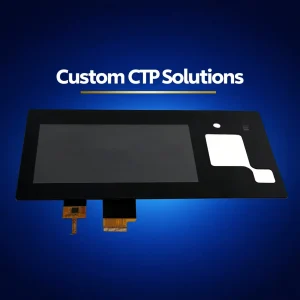
Yes. Many OEM projects require custom mirror display structures based on product appearance, installation space, and functional requirements.
Common customization options include:
- Custom display sizes
- Cover glass printing
- AG/AF coating
- Optical bonding
- Touch panel tuning
- Waterproof structures
- Embedded SBC solution integration
Custom mirror touch screen solutions are widely used in smart home devices, healthcare equipment, industrial systems, and commercial display products.