The TFT LCD (Thin-Film Transistor Liquid Crystal Display) technology has been used in the industrial, medical, automobile and consumer electronics industries. Although it is a mature product one of the most commonly talked about issues is LCD screen bleed, which is also referred to as LCD light leakage or an uneven brightness. For engineers, buyers, and product designers, understanding this phenomenon is essential when evaluating a high-quality display.
This article provides a structured overview of what LCD screen bleed is, why it occurs, how it is evaluated in real-world projects, and how it can be minimized through optimized design and manufacturing practices.
What Is LCD Screen Bleed? Backlight Bleeding Definition in IPS LCD Display
LCD screen bleed, also known as LCD light leakage or backlight bleeding, refers to the unintended escape of light from certain regions of a display panel. This is generally noticeable at the edges or corners of the screen particularly when the content on the screen is dark or black. In some cases, it may appear as slight bright patches, halos, or uneven brightness distribution.
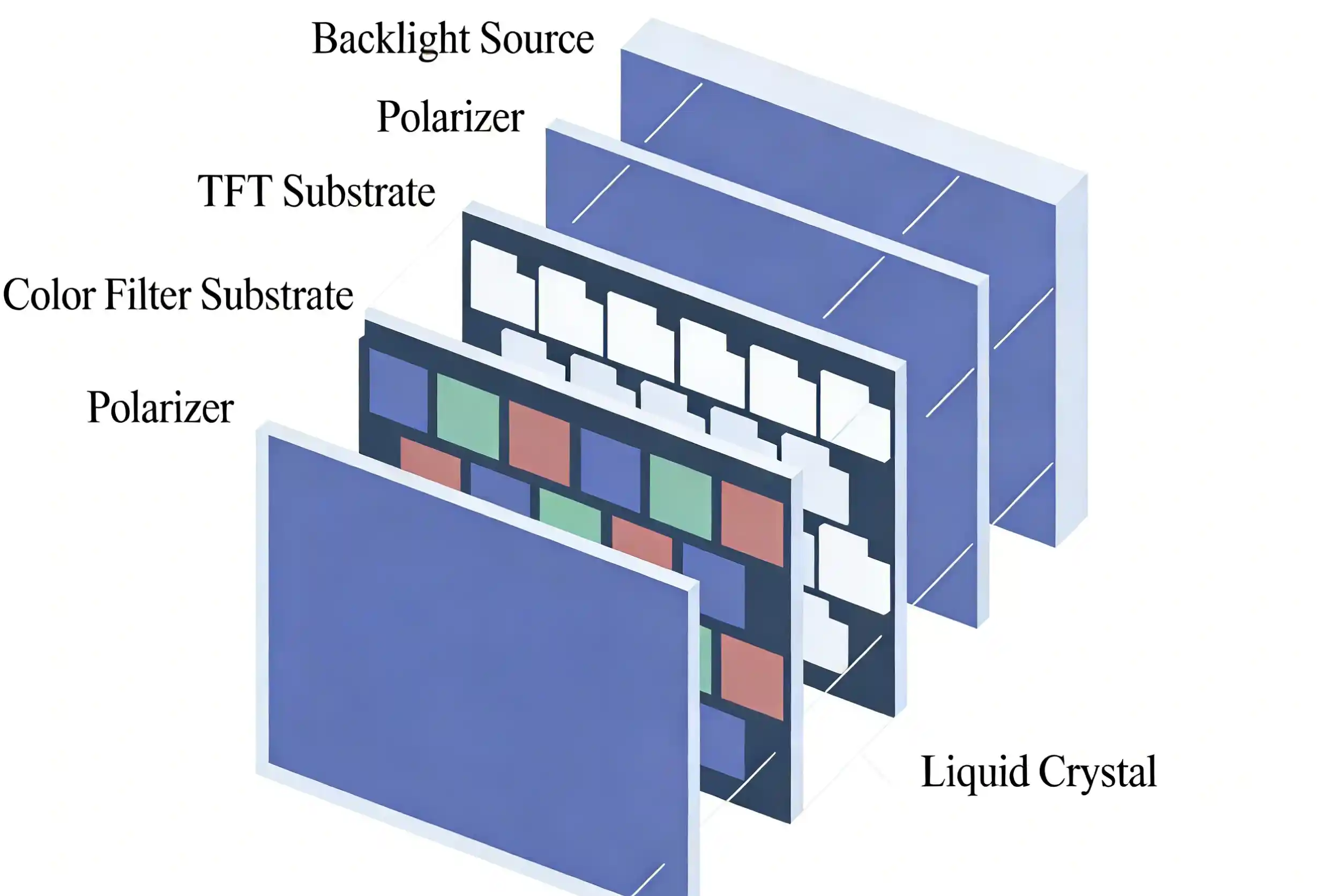
In comparison to OLED or other self-emissive technologies, LCD panels are based on a system of a backlight. The light produced by the backlight penetrates through several layers of optics such as the light guide plate, diffuser films, and liquid crystal layer and creates an image. Because of this stratified structure, some slight light deviation cannot be avoided even in displays with high quality of the TFT-LCD.
The phenomenon becomes more noticeable under specific conditions:
- Full black screen testing (RGB 0,0,0)
- Dark ambient environment
- High brightness or backlight intensity
These effects are more visible on an IPS LCD display because it allows viewing wide angles in comparison with other types of panels. Typical visual characteristics include edge brightness, corner glow, and mild luminance inconsistency across the screen
It is also important to distinguish LCD screen bleed from IPS glow. While both may appear similar, IPS glow is related to viewing angle and panel characteristics, whereas backlight bleeding is primarily linked to structure and assembly factors.
What Causes LCD Light Leakage in Display Panels?
Structural Characteristics of LCD
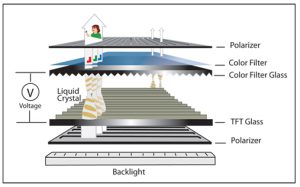
TFT LCD displays are not self-emitting and need an adjustable backlight module that generates light. A TFT-LCD consists of various layers; such as light guide plate, diffuser films, prism films, liquid crystal layer and polarizers. The layers are very important in the guiding, diffusing, and controlling of light to create the intended image.
However, even microscopic inconsistencies, slight gaps, or imperfect adhesion between these layers can cause light to deviate from its intended path. This deviation results in unintended light leakage, which is an inherent challenge of the physical structure of LCD panels. Even in high-quality display, a small amount of light leakage is often unavoidable due to these structural characteristics.
Assembly Process Deviations (Primary Cause)
This will be the usual cause of the visible LCD screen bleed, particularly when the equipment is amid the final assembly phase.
- Uneven frame pressure: If the display bezel applies uneven or excessive pressure to the edges of the screen during assembly, internal optical films or glass substrates may deform. This deformation changes the light path and leads to localized light leakage, particularly at the corners of the display.
- Insufficient alignment or adhesion: Improper gap control between the backlight module and the LCD panel, or misalignment of individual optical layers, can create small gaps. These gaps allow light to escape along unintended paths, further contributing to visible screen bleed.
The mechanical stress and assembly deviation are thus the important factors that influence the uniformity of TFT-LCD display light output. The assembly pressure must be carefully controlled and a perfect match of all the parts must be taken to reduce the backlight leakage.
Material and Design Factors in High-Quality Display
- Glass Substrate Thickness: Thinner glass substrates (e.g., 0.5T) are lighter and more compact but have lower rigidity. They are more likely to deform under the external force and this may deviate the light path and cause backlight leakage.
- Light Guide Plate and Film Quality: Any defects or unevenness in the light guide plate, diffuser films, or brightness enhancement films can cause inconsistent backlight distribution, leading to visible screen bleed.
- Adhesive Materials (Gaskets and Double-Sided Tapes): Adhesives used to secure internal components must have consistent adhesion and uniform application. Old age, irregular coating, or inadequate adhesive capacity can result in minor crevices, release of light in a random manner.
Careful material selection, precise design, and strict manufacturing control are essential to ensure optical consistency, structural stability, and high display quality.
Environmental Influences
- Temperature and Humidity: A substantial variation in temperature and humidity may result in varying rates of expansion and contraction of various materials (i.e., metal frames, plastic gaskets, glass). This may compromise the original sealing and create small gaps that allow light to leak.
- Long-Term Use and Vibration: Extended usage or vibrations during shipping can cause internal screws to loosen or components to shift slightly. Such minimal movements can change the light path and increase the light bleeding into the backlight.
The Liquid Crystal Panel Manufacturing Characteristics
During the fabrication of liquid crystal panels, process-related factors such as the friction treatment of the polyimide (PI) alignment layer, which controls the orientation of liquid crystal molecules, and the distribution and uniformity of spacers, directly affect the consistency of the liquid crystal cell gap. Localized light leakage due to variation in cell thickness may also manifest as so-called pressure-induced Mura, and thus, a well-controlled process is necessary to achieve a homogeneous quality of the display.
Is LCD Screen Bleed Normal in High-Quality Display Products?
Why It Occurs in IPS LCD Display
Although LCD technology has a level of bleed in its screens, some level is normal. Since the show depends on a backlight system, it is immensely hard to remove the light leakage entirely. This is especially so when it comes to IPS LCD display panels with high viewing angles and slim designs.
Acceptable Range of LCD Light Leakage
In practical applications, the key consideration is whether the LCD light leakage falls within an acceptable range. Minor edge brightness that is only visible under extreme test conditions is generally acceptable. A high-quality display is expected to maintain uniform performance during normal usage scenarios.
However, the following conditions are typically considered unacceptable:
- Bright spots in central viewing areas
- Severe uneven brightness affecting image quality
- Visible light leakage during normal content display
Common Misunderstandings
LCD screen bleed has a number of myths. There are users that believe that any visible light means that there is some kind of defect whereas there are users who assume that the levels should be entirely black. As a matter of fact, even display products of high quality might have slight differences at extreme conditions. It should be always practical performance as opposed to laboratory test conditions.
LCD Screen Bleed Standards and Testing Methods
Standard Testing Conditions
In order to measure LCD light leakage, manufacturers normally apply institutionalized testing conditions. These involve showing a solid black picture, testing in some dark room, viewing the panel with specified angles and distances. These conditions aid in bringing about uniformity and comparability among various products.
Luminance Measurement
To perform quantitative analysis, luminance meters are referred to in order to measure the difference in brightness between affected sections and the screen center. This will give a objective approach in assessing the LCD screen bleed and to establish whether LCD meets the internal quality standards or not.
Application-Specific Requirements
Different industries may have different standards for acceptable LCD light leakage. Industrial applications may tolerate slight edge effects, while medical or automotive displays often require stricter uniformity and consistency. Therefore, defining project-specific requirements is critical when selecting a high-quality display solution.
How to Reduce LCD Screen Bleed in High-Quality Display Design
Minimizing LCD screen bleed requires a combination of careful design, material selection, and precise manufacturing. Mechanical design improvements—such as balanced frame pressure, optimized bezel structures, and light-blocking features—help reduce visible leakage. Choosing high-quality, stable materials, including uniform light guide plates and reliable adhesives, further ensures optical consistency.
It is also necessary to have a tight control over manufacturing process. Clean room assembly, component positioning, pressure control help in controlled performance and reduce back light leakages. Moreover, the sophisticated design simulations enable the engineers to estimate the spread of light and pinpoint the areas of possible issues in advance and eliminate the prototyping cycles and enhance the overall reliability of the products.
Lastly, it is important to choose a supplier who is well experienced and has a good quality management. A capable partner can maintain LCD screen bleed within acceptable limits across batches through engineering expertise, process control, and continuous technical support.
Conclusion
LCD screen bleed is an inherent characteristic of TFT LCD technology. Though it is impossible to eradicate it, it can be successfully suppressed by the help of optimized design, choice of materials, and production process.
The most important thing to engineers and buyers is to analyze whether the display can be utilized in the real world and in a reliable manner. A high-quality display should offer stable performance, minimal visual impact, and long-term durability, ensuring it meets the requirements of its intended application.