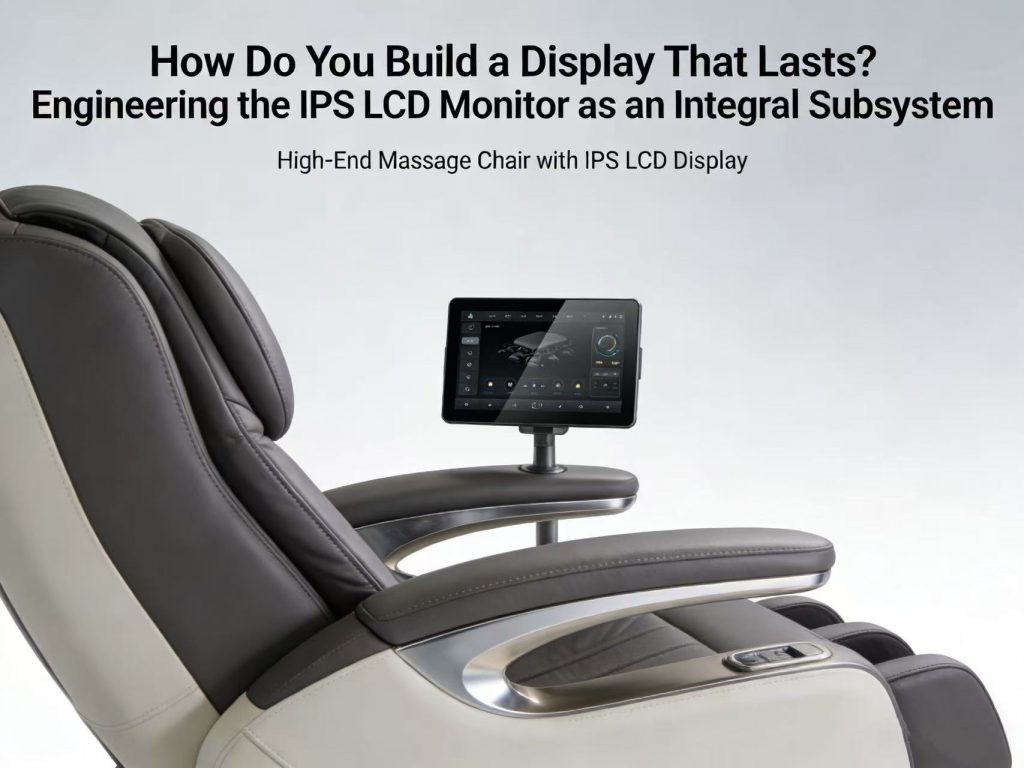
Integrating a high-performance IPS LCD Monitor into a device like a premium massage chair is a serious engineering challenge. This goes far beyond just picking a screen from a catalog. It requires a purpose-built Custom Display Solution. Every detail—from power signals and physical fit, to surviving daily use and looking crystal clear—must be tailored to the product’s exact needs.
The goal is deep integration. The display shouldn’t feel like an added accessory. Instead, it must become a seamless, reliable, and intuitive core part of the system. It defines how users interact with the product and ensures the device lasts for years.
This analysis breaks down the five key engineering pillars that make this integration possible.
Custom Display Solution: The Foundation of Seamless Integration
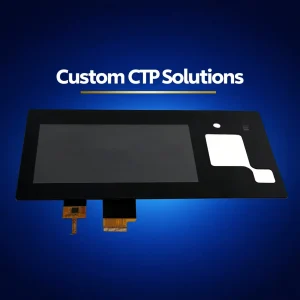
A true custom display solution means starting from scratch. Forget about modifying an off-the-shelf panel. It begins with close collaboration between your engineers and the display manufacturer. Together, they specify every single parameter—how it will look, how it will fit, and how it will function.
The mechanical team defines the precise dimensions, mounting points, and bezel shape. The goal is a flush, integrated look that seems born from the product’s design, not attached to it.
Simultaneously, optical engineers dial in the performance. They specify high brightness (often 500 nits or more) to combat glare, and a uniform color temperature across the entire screen. This ensures on-screen health data is not only comfortable to view but also accurately represented.
This end-to-end, bespoke approach is what transforms the IPS LCD monitor from a purchased component into a native, seamless part of the product itself.
| Customization Dimension | Engineering Specifications & Targets | Impact on Final Product Quality |
|---|---|---|
| Mechanical Form Factor | Tailored cover glass dimensions, thickness (e.g., 1.1mm tempered glass), and bezel width. Custom mounting brackets. | Achieves a seamless, “designed-in” aesthetic with no visual gaps or misalignments. Enhances premium perception. |
| Optical Performance | Calibrated backlight brightness (500-1000 nits), uniform color temperature (e.g., 6500K), and high contrast ratio (>1000:1). | Guarantees perfect readability in bright living rooms and provides a visually consistent, strain-free interface. |
| Touch Integration | Selection of cover lens material (anti-glare, anti-fingerprint coatings), integration of projected capacitive (PCAP) touch sensor. | Ensures reliable, durable touch interaction that feels responsive and retains clarity over years of use. |
Human-Machine Interface (HMI): The Tangible Interaction Layer
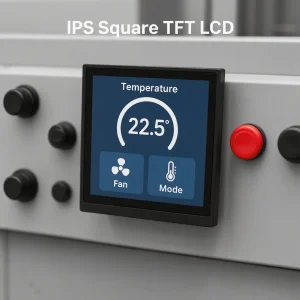
The IPS LCD Monitor is where your product’s interface comes to life. It’s the tangible layer you actually see and touch.
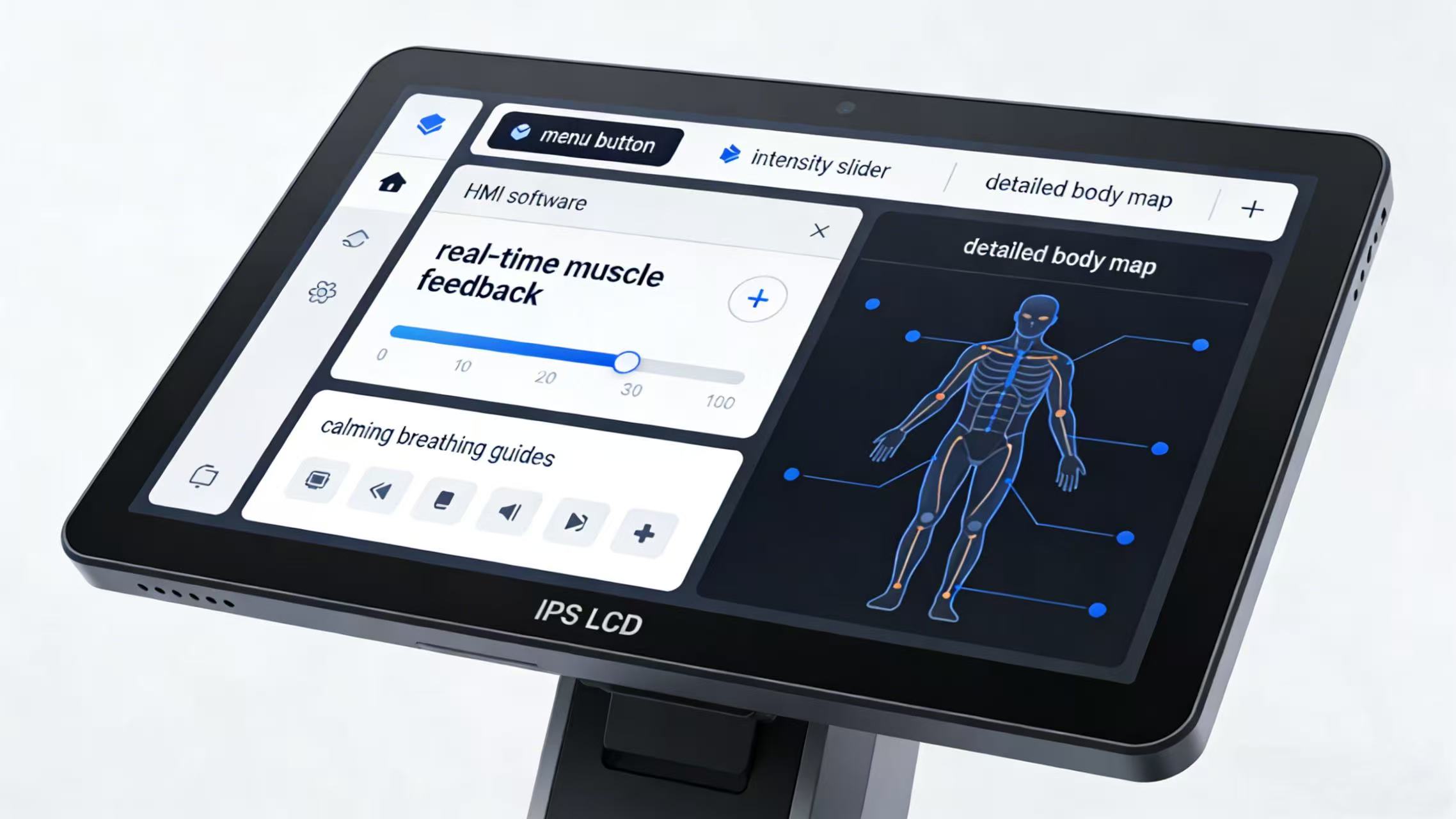
This is why the innate benefits of IPS technology are crucial. Its consistent color and wide viewing angles mean that every on-screen element—be it a menu button, an intensity slider, or a detailed body map—stays perfectly clear and selectable, no matter how you’re reclined.
On this stable and uniform visual foundation, the HMI software can do its job effectively. It can present everything from real-time muscle feedback to calming breathing guides without distortion or loss of clarity. Finally, the combination of a responsive touch layer and the monitor’s quick pixel response eliminates lag. This synergy makes the interaction feel immediate and precise, giving the user a true sense of direct control.
In essence, the IPS LCD Monitor is the vital hardware bridge that turns software instructions into an intuitive and satisfying physical interaction.
Wide-Temperature Performance and Environmental Ruggedness
Think about where a massage chair lives: a cool basement one day, a sunny patio the next. The display has to keep up. This means the IPS LCD Monitor must be built for extreme temperatures. Its internal components are chosen to operate flawlessly from freezing cold to intense heat.
The result? Instant response even on a chilly morning, with no sluggish pixels. In a warm room, the image stays stable—no fading, ghosting, or unexpected blackouts. But temperature is just one hurdle. The display must also be tough. It undergoes rigorous shaking (to simulate years of motor vibration), shock tests, and humidity checks.
This validation proves the display won’t fail. Its connections stay secure, and the screen remains intact through a decade of daily use in a real home environment.
Industrial-Grade Interfaces and Power Integrity
Getting a clean signal from the main processor to the IPS LCD Monitor is an electrical design challenge. It starts with choosing the right industrial-grade interface.
For reliability in noisy environments, LVDS is a proven workhorse. It excels at rejecting electromagnetic interference, which is vital when the display cable routes past motors and drivers. Where future graphics performance is a priority, Embedded DisplayPort (eDP) provides the higher bandwidth needed for richer colors and sharper details.
However, a perfect signal is worthless with dirty power. The display’s voltage supply must be meticulously clean. Even minor noise or ripple here can introduce visible screen flicker or strange artifacts.
Achieving this requires careful design: strategic filtering, effective shielding, and a clean circuit board layout. This disciplined approach to power integrity is what ultimately guarantees the IPS LCD Monitor a stable, flawless image in all conditions.
| Interface / Electrical Standard | Key Technical Characteristics | Rationale for Selection in Wellness Products |
|---|---|---|
| LVDS (Low-Voltage Differential Signaling) | Differential signaling provides high common-mode noise rejection. Lower EMI emissions. | Excellent resilience against electromagnetic interference from nearby motors and power supplies. Proven reliability. |
| eDP (Embedded DisplayPort) | High serial bandwidth, supports higher resolutions and refresh rates. Auxiliary channel for touch data. | Enables more complex, animated graphics. Reduces cable count by consolidating video and touch data. |
| Power Integrity Design | Use of dedicated LDOs/regulators, π-filters, and careful PCB ground plane design for the display. | Prevents visible screen noise, flicker, or instability caused by electrical noise from other subsystems. |
Optical Bonding Technology: Enhancing Performance and Durability
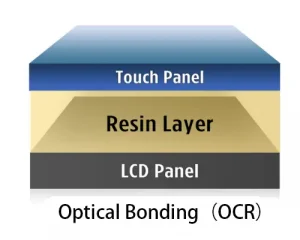
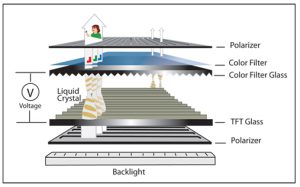
Optical bonding is a critical manufacturing step. It fuses the cover glass directly to the IPS LCD Monitor’s screen using a crystal-clear adhesive layer, eliminating the usual air gap. The payoff for the final product is clear. First, it cuts down internal reflections dramatically—like wiping a foggy window. This makes the screen perfectly readable in sunlight and boosts perceived contrast.
Second, it turns multiple layers into a single, rugged block. The display becomes much more resistant to impacts and stops internal condensation in humid settings.
Finally, it brings your finger closer to the graphics beneath the glass. This reduces the “parallax” gap, making every touch feel direct and accurate.
Yes, it adds cost. But in a high-end product, optical bonding is the definitive mark of a custom display solution. It’s what delivers a screen that’s not just seen, but reliably felt and used.
Conclusion: The Display as an Engineered Subsystem
Ultimately, integrating an IPS LCD Monitor into a premium product is a systems engineering challenge. It starts with a custom display solution for perfect fit and form. This display becomes the foundation of an intuitive and reliable human-machine interface. Its resilience is proven through wide-temperature operation and rigorous environmental testing.
Robust industrial interfaces and clean power design ensure signal and energy are delivered flawlessly. Optical bonding then seals the deal, enhancing both durability and visual clarity. In the end, a truly engineered product treats its display not as a commodity, but as a bespoke, mission-critical subsystem. It is fundamental to how the product functions, feels, and endures.