Introduction
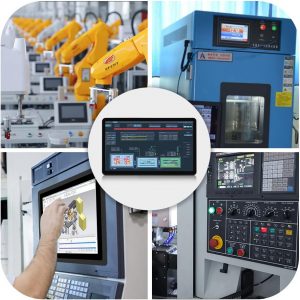
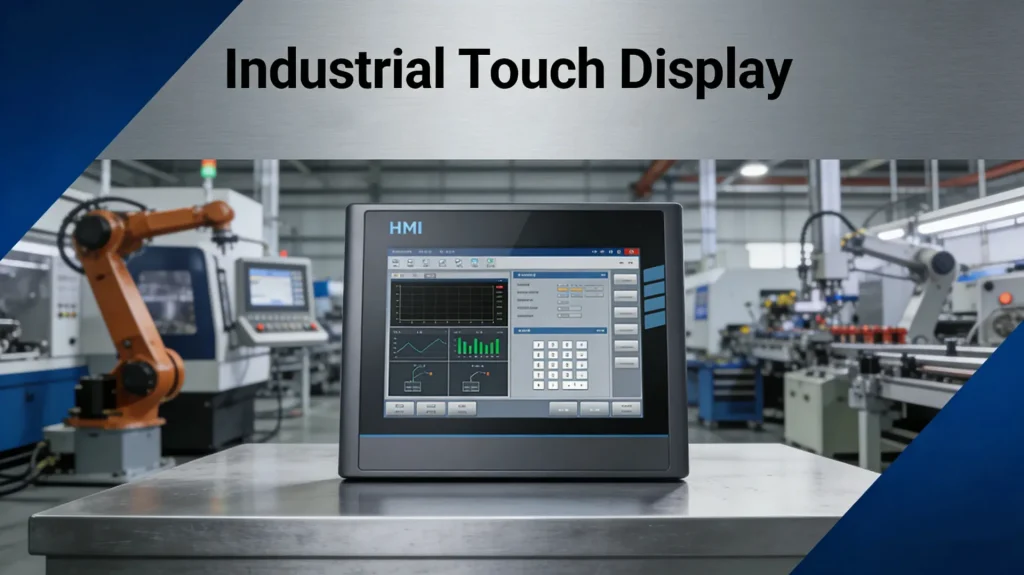
With the shift of industries to automation and their digital production, human-machine interaction is now an important part of the modern equipments. Operators must have a sound mechanism of monitoring system status, controlling equipment and retrieving operational information within real time. In this case, the Industrial Touch Display will be necessary.
The industrial touch displays are designed to be stable and durable unlike the touchscreens in consumer electronics. They have to remain in settings where they have dust, vibration, changes in temperatures, and continuous usage. In most industrial uses, displays operate 24 hours a day and are supposed to last many years before they fail.
Touch screens have become commonplace in factory automation systems, transport kiosks, energy infrastructure, health equipment and interactive kiosks. They enable operators to communicate with complex systems by use of easy-to-use graphical interfaces; making controlling machines easier and more effective.
What is an Industrial Touch Display?
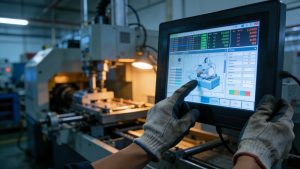
An Industrial Touch Display, sometimes referred to as an industrial touchscreen display or industrial touch screen monitor, is a rugged display interface designed specifically for industrial environments.
These displays are normally incorporated to equipment like:
-
Industrial PCs
-
PLC control systems
-
SCADA platforms
-
Automation equipment implemented within
-
Forklift monitoring terminals
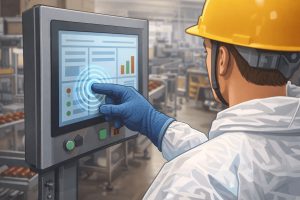
Operators are able to monitor machine data, to modify parameters and to view production processes on the screen through graphical interfaces.
Industrial touch displays are built to have long-term reliability as opposed to consumer displays. They tend to offer longer average temperatures, greater mechanical stability and longer life cycles of the products. The display model in most instances is required to last five or ten years so as to come up with continuous equipment manufacturing.
Due to these demands, industrial displays are developed not only interchangeably with consumer items in hardware design but also component choice.
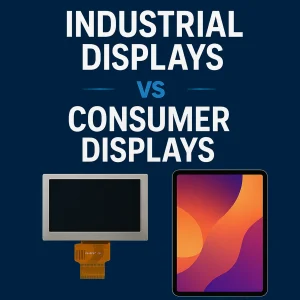
Industrial Touch Display vs Consumer Touchscreen
Although industrial displays and consumer touchscreens may appear similar at first glance, their design priorities are quite different.
| Feature | Industrial Touch Display | Consumer Touchscreen |
|---|---|---|
| Durability | Designed for harsh environments | Designed mainly for indoor use |
| Operating time | Continuous 24/7 operation | Intermittent usage |
| Temperature range | −20°C to 70°C | Typically 0°C to 40°C |
| Product lifecycle | Often 5–10+ years | Usually replaced within 1–3 years |
| System integration | PLC, SCADA, industrial PCs | Smartphones, tablets |
For industrial equipment manufacturers, using consumer-grade displays can create long-term risks such as reduced durability or unexpected product discontinuation.
Core Technologies Behind Industrial Touch Displays
There are numerous touchscreen technologies accessible to industrial displays, and they have their benefits when it comes to the application scenario.
Resistive Touch Technology
Industrial systems have been operating on resistive touchscreens over the years. They are made of two conductions with a small spacing. Under pressure, the layers will come in contact and the system records this point of contact.
The primary advantage of resistive technology is that it is versatile. The touchscreen is usable by a finger, stylus and even heavy industrial gloves. It also works well under conditions where water or dust can be found.
Due to its efficiency and rather cheap price, resistive touch technology remains very popular in the traditional machine control panel as well as in some industrial equipment.
However, resistive displays generally support only single-touch input and may offer slightly lower optical clarity compared with modern capacitive screens.
Capacitive Touch Technology
Capacitive touchscreens work by detecting changes in the electrical field across the screen surface. The controller compares the change in capacitance when an object with a conductive response like a human finger touches the screen and then calculates the position of the touch.
Capacitive displays have been distinguished by their smooth response and high quality image. They provide multi-touch features, including zoom and swipe, which are useful in the contemporary graphical interface.
For many newer industrial HMI systems, capacitive touchscreens provide a user experience similar to smartphones while maintaining industrial reliability.
Projected Capacitive (PCAP) Technology
Projected capacitive (PCAP) is a technology of the capacitive type, and it has been the most widespread solution in modern industrial touch screens.
PCAP screens use a fine conductive grid embedded inside the glass layer. The structure enables the system to sense several touch points with a lot of accuracy even in comparatively thick protective glass.
Key advantages include:
-
Multi-touch gesture capability
-
Durable glass surface
-
Compatibility with protective cover lenses
-
Long operating life
-
Support for industrial gloves
Many modern automation systems and advanced HMI interfaces now rely on PCAP touch technology.
Research and technical publications from organizations such as the IEEE frequently discuss emerging technologies used in industrial electronics and intelligent manufacturing systems.
Infrared Touch Technology
The IR touch displays make use of a series of invisible infrared beams that are placed at the edges of the display. The location of the touch is determined by the system when an object comes in between these beams.
It is very durable, and the optical clarity is good since this technique does not enforce any physical touch layer on the screen. Infrared technology is also applied in large format displays like industrial displays, kiosk, and interactive information systems.
Key Features of Industrial Touch Displays
Industrial displays must meet strict requirements to ensure reliable operation in demanding environments.
Rugged Mechanical Design
Industrial touch displays have common reinforced structures designed to withstand mechanical forces on the display screen and the internal components.
Protective measures which are common are:
-
Tempered or strengthened glass
-
Aluminum or metal housings
-
Shock-resistant mounting structures
These designs assist in sustaining the display to vibration, mechanical impact and incessant usage within production facilities.
Wide Operating Temperature
The machinery in industries might work in conditions with different temperatures.
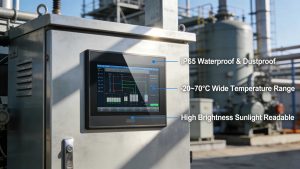
Most industrial touch screens have been designed to work well in the range of−20°C to 70°C. his can enable them to undergo outdoor installation and transportation systems as well as manufacturing facilities.
High Brightness and Sunlight Readability
Displays used in outdoor or brightly lit environments require higher brightness levels to remain readable.
Industrial displays often incorporate:
-
High-brightness LCD panels (800–1500 nits)
-
Anti-glare coatings
-
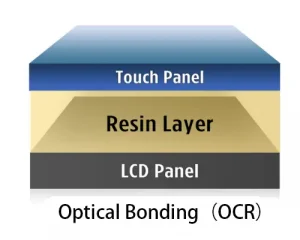
Optical bonding technology
These features improve visibility and reduce reflections under strong lighting conditions.
Dustproof and Waterproof Protection
Industrial environments frequently involve exposure to dust, oil, and moisture. To protect the display, many industrial touch panels are sealed to meet protection ratings such as:
-
IP65 – dust-tight with water resistance
-
IP67 – protection against temporary water immersion
These protection levels ensure reliable operation in challenging conditions.
Industrial Touch Display Hardware Components
Understanding the internal components of an industrial display can help engineers choose the most suitable solution.
LCD Display Panels
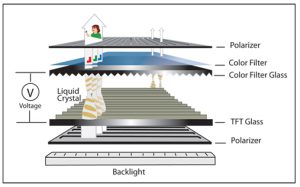
In the majority of industrial displays, TFT LCD panels are used and they have LED backlights. This is a technology that gives a decent balance of brightness, energy efficiency and longevity.
The main requirement of LCD panels in the industrial systems is high quality, which gives the system stability in color performance and extended usage.
Touch Controllers
The touch controller is responsible for processing touch input and transmitting signals to the host system.
Common communication interfaces include:
-
USB
-
I²C
-
RS-232
-
SPI
A reliable controller ensures accurate and responsive touch performance.
Protective Glass and Surface Treatment
Industrial displays often use strengthened glass combined with specialized surface treatments such as:
-
Anti-scratch coating
-
Anti-glare coating
-
Anti-UV treatment
-
Chemical strengthening
These treatments help maintain display clarity while improving durability.
Common Industrial Touch Display Sizes
Industrial equipment manufacturers select different screen sizes depending on the application and available installation space.
5-inch Industrial Touch Display
5-inch displays are often used in compact control systems or embedded industrial devices where space is limited.
7-inch Industrial Touch Display
7-inch touch displays are among the most widely used sizes in industrial HMI panels and automation equipment, offering a good balance between screen size and installation flexibility.
10.1-inch Industrial Touch Display
10.1-inch displays are commonly found in advanced control interfaces where larger graphical dashboards are required.
15.6-inch Industrial Touch Display
15.6-inch full-HD displays are typically used in industrial monitoring terminals, workstation interfaces, and larger control systems that require detailed data visualization.
Industrial Standards and Compliance
Industrial electronic equipment must follow international standards to ensure safety and compatibility.
Organizations such as the International Organization for Standardization (ISO) develop global standards that guide the design, safety, and performance requirements of industrial systems.
Major Applications of Industrial Touch Displays
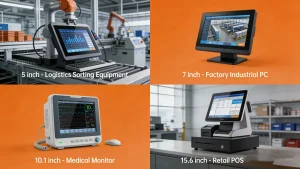
Industrial touch displays are applied in numerous industries that are in need of a human-machine interface that can be trusted.
Manufacturing and Factory Automation
Touch displays are used in manufacturing plants, where they can be embedded in the machine control panels, enabling the operator to check the production status and modify the equipment parameters in real time.
Resources in the industry like Automation.com emphasize the role played by human-machine interfaces in current industrial automation systems.
Transportation and Smart Logistics
Industrial displays are common in transport systems in form of control terminals, fleet management centers, and even logistics control tools.
Medical Equipment
Industrial touch displays are used in many medical devices because they are quite stable and precise. They include patient monitoring systems, laboratory instruments and diagnostic equipments.
Energy and Utilities
Industrial displays are used in power plants and energy management facilities to observe the performance of the system and react to changes in system operation in real time.
Self-Service and Kiosks
Industrial touch displays are also common in self-service terminals such as ticketing machines, information kiosks, and automated retail systems.
How to Choose the Right Industrial Touch Display
Selecting the right display requires evaluating several technical and environmental factors.
Important considerations include:
-
Environmental conditions such as dust, humidity, and temperature
-
Screen size and resolution requirements
-
Mounting options and installation space
-
Interface compatibility with the host system
-
Long-term product availability
Choosing a display with stable long-term supply is particularly important for industrial equipment manufacturers.
Why Work With a Professional TFT LCD Supplier
For equipment manufacturers, choosing a reliable display supplier can be just as important as selecting the touchscreen technology itself.
An experienced TFT LCD supplier can provide:
-
Long-term product availability
-
Customized screen sizes and interfaces
-
Optical bonding solutions
-
Integrated touch display modules
-
Consistent quality for industrial environments
Working with a specialized supplier also helps reduce development time and ensures that the display integrates smoothly with the overall system design.
Future Trends in Industrial Touch Displays
Industrial display technology continues to evolve alongside smart manufacturing systems.
Smart Factory Integration
Touch displays are increasingly integrated with intelligent monitoring systems and predictive maintenance platforms.
Optical Bonding Technology
Optical bonding improves sunlight readability while also increasing mechanical durability and reducing condensation inside the display module.
Edge Computing Interfaces
Future industrial displays may incorporate edge computing capabilities, enabling real-time data processing directly at the device level.
Frequently Asked Questions
What is an industrial touch display?
An industrial touch display is a rugged touchscreen interface designed for use in industrial environments such as factory automation systems, transportation equipment, and industrial control panels.
What touchscreen technology is best for industrial applications?
Projected capacitive (PCAP) technology is widely used because it offers high sensitivity, durability, and multi-touch capability.
Can industrial touchscreens be used with gloves?
Yes. Resistive touchscreens and many industrial PCAP displays are designed to operate with gloves.
What screen sizes are most common?
Typical sizes include 5-inch, 7-inch, 10.1-inch, and 15.6-inch displays.
Conclusion
The modern manufacturing and infrastructure systems are still undergoing changes in industrial automation. The Industrial Touch Display is a major component of human-machine interfaces and allows operators to be able to monitor equipment, control processes and interact with complex systems with increased efficiency.
As technologies in touchscreen technology and display technology progress, industrial displays are growing tougher, responsive and capable of being used in a broad range of applications.
In the case of equipment manufacturers that are designing automation the choices in regards to the type of industrial TFT LCD touch display include the selection of the appropriate types of industrial TFT LCD touch displays to achieve reliable performance, extended product life and improved user experience.