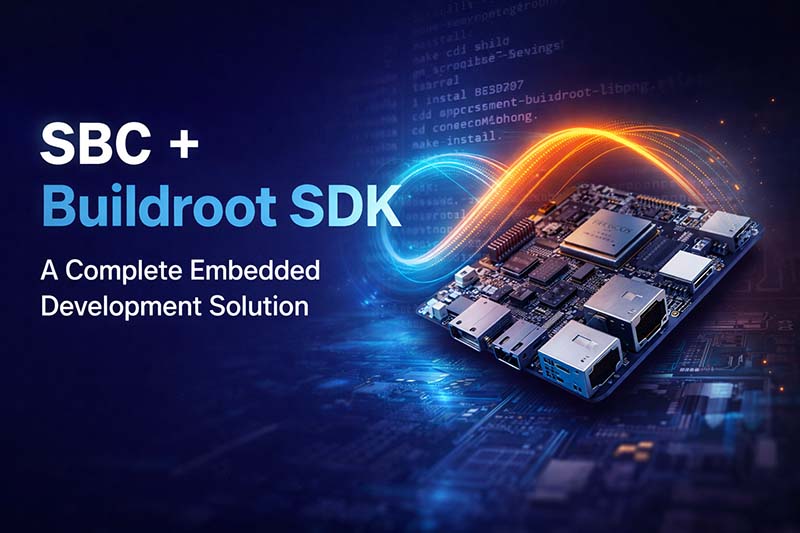
Introduction
In embedded system development, companies often face multiple challenges: hardware design complexity, operating system customization, and application development environment setup. These processes are typically fragmented, requiring different teams and significantly increasing development time and cost.
In real projects, these issues often slow things down. To simplify the process, we typically deliver a complete solution that integrates custom SBC (Single Board Computer) development, Buildroot-based embedded Linux systems, and a ready-to-use SDK (Software Development Kit). This approach enables customers to focus directly on application development without worrying about low-level system configuration.
What Is an SBC-Based Embedded Platform
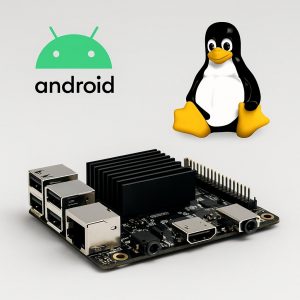
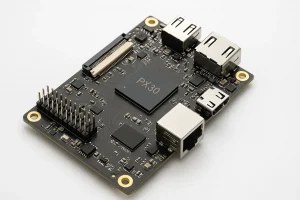
A Single Board Computer (SBC) is a compact, fully functional computer built on a single circuit board. It integrates key components such as the processor, memory, storage interfaces, and peripheral connectivity.
In practice, we see SBC platforms used in a wide range of products, such as industrial controllers, HMI devices, and IoT gateways. including:
-
- Industrial automation and control systems
- Human-machine interfaces (HMI)
- IoT gateways and smart devices
- Medical and automotive electronics
However, hardware alone is not sufficient. A reliable and optimized software platform is essential to unlock the full potential of an SBC.
Why Buildroot for Embedded Systems
Buildroot is widely used for building embedded Linux systems.Compared to Yocto, it is much simpler to get started with — especially for product-oriented projects where fast iteration matters. Compared to more complex solutions, Compared to more complex frameworks like Yocto, Buildroot is much easier to set up and maintain.
Key advantages of Buildroot include:
- Lightweight and efficient: Generates minimal root filesystems tailored to the application
- Fast build times: Ideal for rapid development and iteration
- Highly customizable: Flexible configuration for packages, libraries, and system features
- Production-ready: Suitable for commercial embedded products
These characteristics make Buildroot an excellent choice for embedded platforms that require both performance and simplicity.
Our Development Workflow
1. Custom SBC Hardware Development
In most projects, we start by designing the SBC hardware based on the customer’s performance and interface requirements. The setup process is straightforward. Typically, it only takes a few steps:
- Processor (SoC) selection based on performance and power requirements
- Peripheral interface design (USB, Ethernet, HDMI, GPIO, etc.)
- PCB layout and hardware validation
- Board bring-up and initial testing
2. Buildroot System Customization
Once the hardware platform is ready, we develop a customized Buildroot-based Linux system:
- Linux kernel configuration and optimization
- Device driver integration
- Root filesystem generation with required libraries and packages
- Middleware and system service integration
The result is a stable, optimized, and production-ready embedded Linux system tailored to the SBC.
3. SDK and Toolchain Delivery
A key part of our solution is the delivery of a complete Buildroot SDK, which includes:
- Cross-compilation toolchain
- Pre-configured build environment
- Header files and libraries matching the target system
- Documentation for application development
With this SDK, customers can immediately start developing applications without needing to configure complex build environments from scratch.
What Customers Can Do with the Buildroot SDK
After receiving the SDK, customers gain a fully functional development environment that allows them to:
- Develop and compile custom applications using C/C++
- Deploy applications directly to the SBC platform
- Integrate third-party libraries and frameworks
- Perform rapid testing and iteration
This significantly reduces development complexity and accelerates product delivery.
Developer Guide: Using the Buildroot SDK
One common question from customers is whether they need to build the toolchain themselves. The answer is no — the SDK we provide is already fully prepared.
1. Environment Setup
Before starting application development, the SDK environment needs to be initialized:
cd rk3566_linux6.1-aarch64-buildroot-linux-gnu_sdk-buildroot/
./relocate-sdk.sh
source environment-setup
This step configures the cross-compilation toolchain and necessary environment variables.
2. Cross-Compiling a Third-Party Library
The SDK allows developers to easily compile third-party libraries. For example, compiling libpng:
cd $HOME
git clone https://github.com/pnggroup/libpng.git
cd libpng
mkdir build
./autogen.sh
./configure --host=aarch64-buildroot-linux-gnu --prefix=$HOME/libpng/build
make
make install

# Check ELF file
file build/lib/libpng*
This ensures the generated binaries are compatible with the target SBC architecture.
3. Building Your Own Application
After setting up the environment, developers can compile their own applications:
$CC main.c -o app
The generated binary can be directly deployed to the target SBC and executed.
Advantages of Our Solution
- Faster time-to-market: Eliminates the need for low-level system setup
- Reduced development cost: Minimizes engineering effort and resource requirements
- Stable and validated platform: Hardware and software are fully tested and optimized
- Scalable and customizable: Easily adapt the platform to different product requirements
Typical Use Cases
- Industrial control systems
- Smart home and IoT devices
- Human-machine interface (HMI) solutions
- Edge computing and AI applications
- Medical and automotive electronics
Conclusion
Our Custom SBC + Buildroot SDK solution provides a complete embedded development platform that bridges the gap between hardware and application development. By delivering a ready-to-use system and toolchain, we enable our customers to focus on innovation rather than infrastructure.
If you are working on a project and need a stable embedded platform, this approach can significantly reduce your development effort.